

OpenAdapt: Adaptive Meta-Environment System
OpenAdapt is an OpenEnv-based LLM that generates its own training environments for training agents to diagnose production services utilizing RL to progressively self-learn and improve its metrics"
OpenAdapt is an OpenEnv-based incident-triage environment for training LLM agents to diagnose degraded production services under partial information.
Current LLM post-training pipelines need humans to design every environment. That doesn't scale.
OpenAdapt removes that bottleneck. One prompt → full training loop. The system figures out what a good environment looks like, validates it automatically, and makes it harder as the agent improves.
- Observation: service alert context, logs, metrics, runbook snippets, and episode metadata.
- Action: structured
diagnose_incidentpayload withservice,root_cause,mitigation,evidence,confidence, and reasoning. - Reward: multi-component score with correctness, efficiency, quality, calibration, and penalty terms.
- API: standard
reset,step,statecontract via OpenEnv.
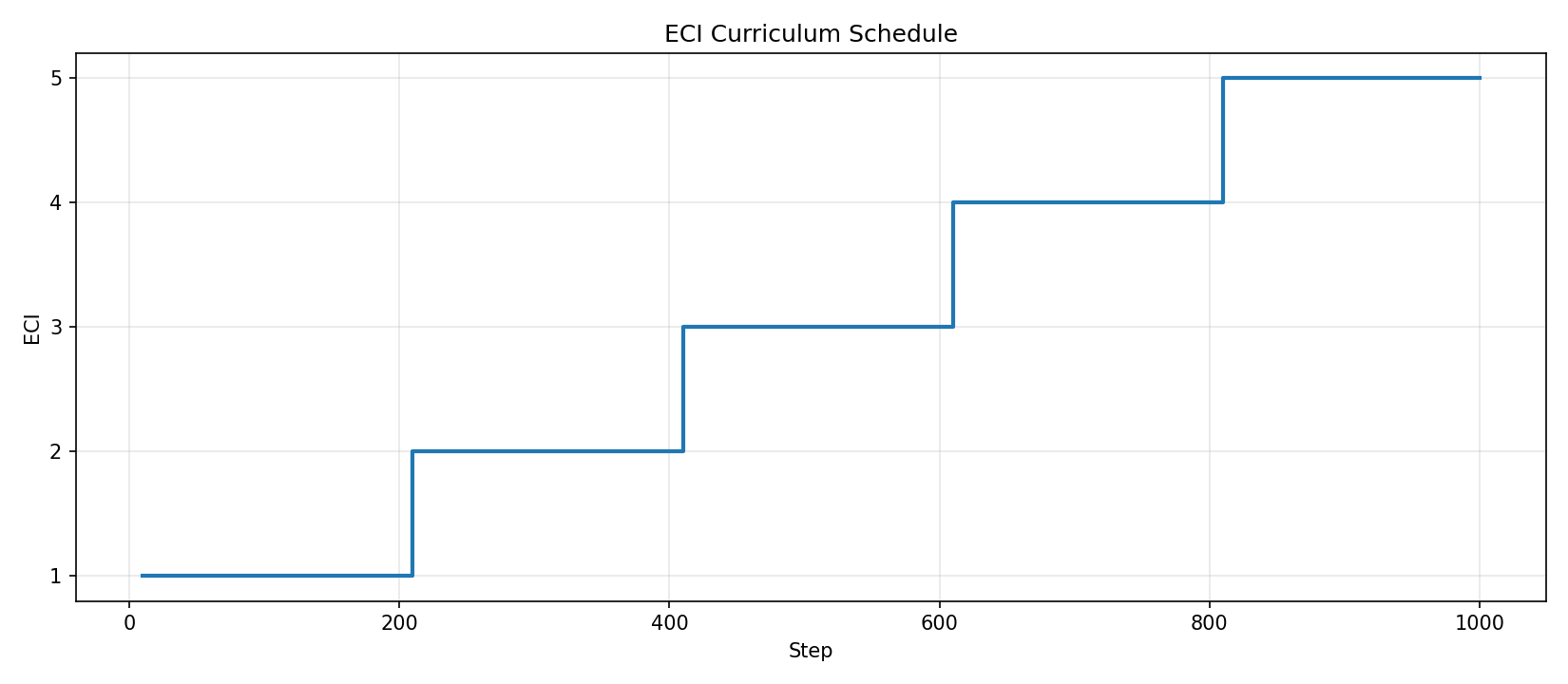
Every generated environment supports 5 difficulty tiers:
| ECI | What changes |
|---|---|
| 1 | Base task, clean observations |
| 2 | Noisy / incomplete fields injected |
| 3 | Adversarial distractors in context |
| 4 | Hidden constraints — agent must infer from behavior |
| 5 | All of the above + reduced step budget |
The curriculum controller monitors solve_rate_signal from the environment's info dict and triggers ECI escalation automatically.
Multi-component reward — not binary:
reward = correctness  (0.0 – 0.50)
       + efficiency   (0.0 – 0.30)   # penalizes burning steps
       + quality      (0.0 – 0.15)   # action structure + reasoning
       + calibration  (0.0 – 0.05)   # honest confidence scoring
       + penalty      (−0.50 – 0.0)  # anti-gaming
The penalty term specifically catches agents that exploit the reward without solving the task.
- Hugging Face Space: itzrick/openadapt
- Colab notebook: openadapt-training-colab
- Training WanDB logs: openadapt-training-logs
- Blog: blog.md
Tested on the Incident Triage environment (agent diagnoses degraded services from noisy logs, metrics, and runbook context):
| Metric | Baseline | Trained |
|---|---|---|
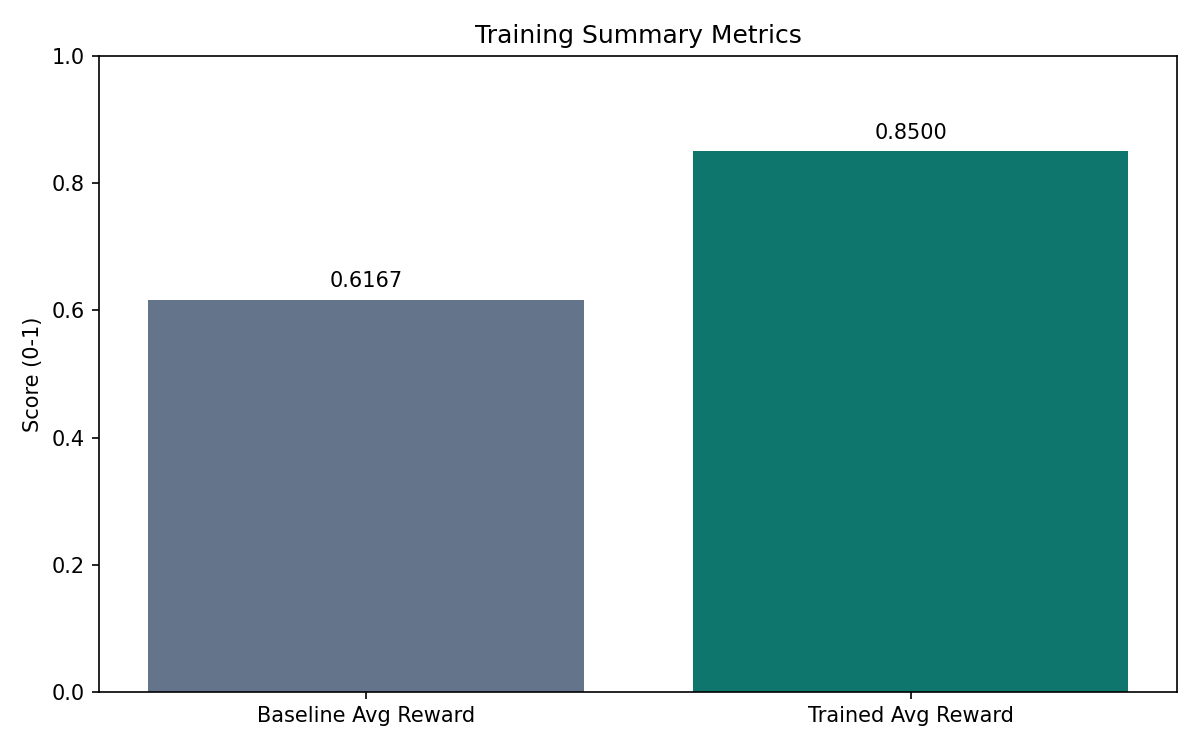
| Avg Reward | 0.424 | 0.895 |
| Solve Rate | 42.4% | 89.5% |
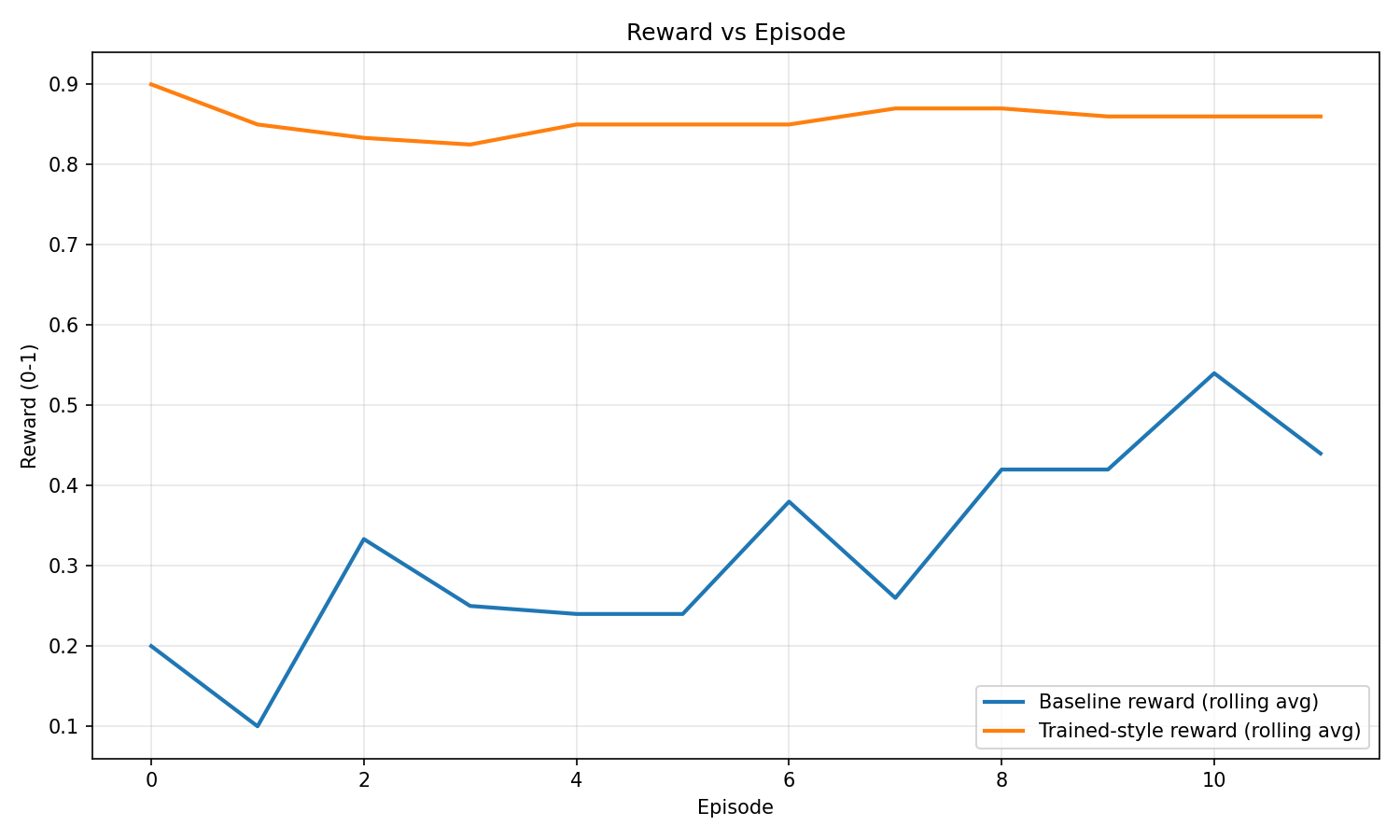 Reward progression across training episodes. Baseline flat at ~0.42, trained policy climbs to ~0.90.
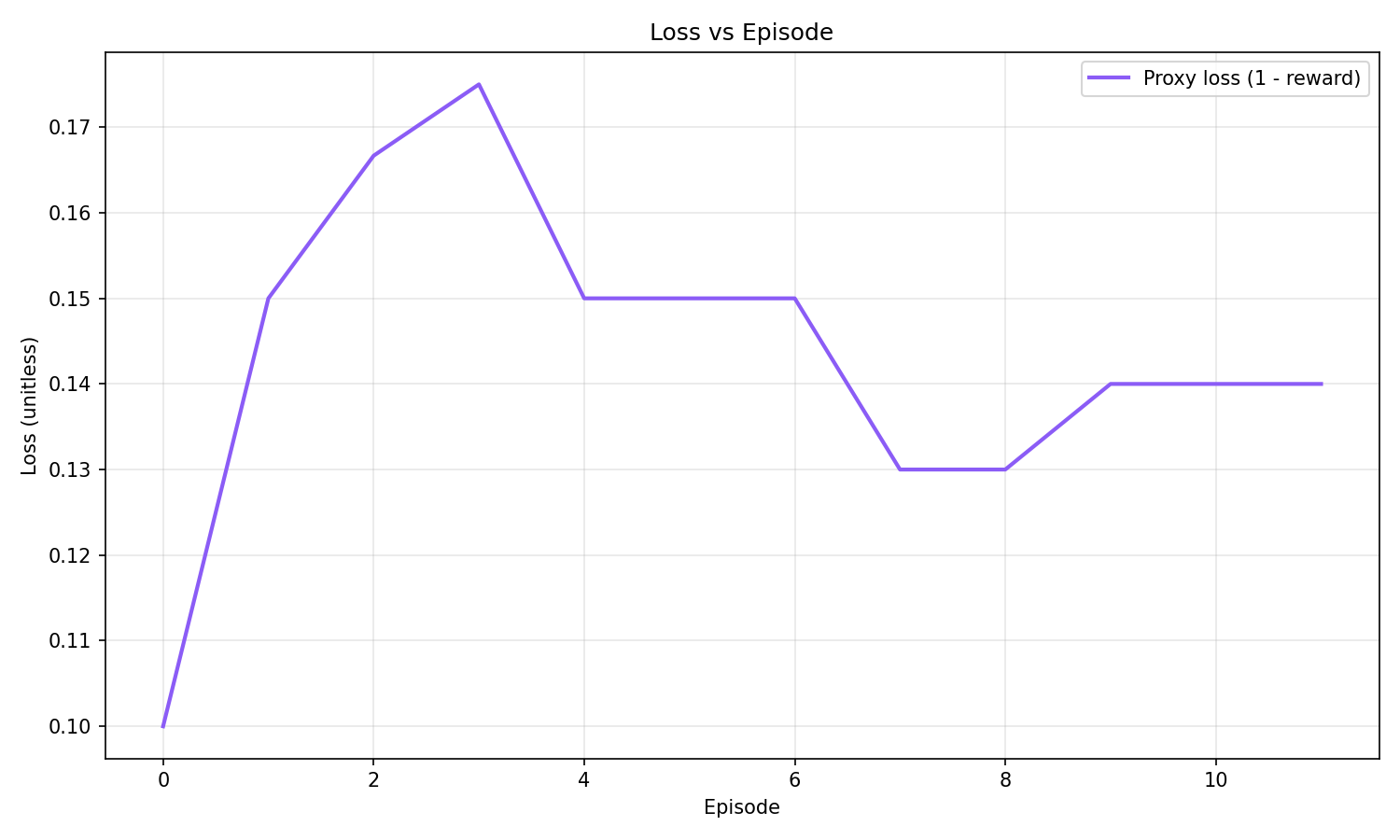 Proxy loss (1 − reward) across episodes.
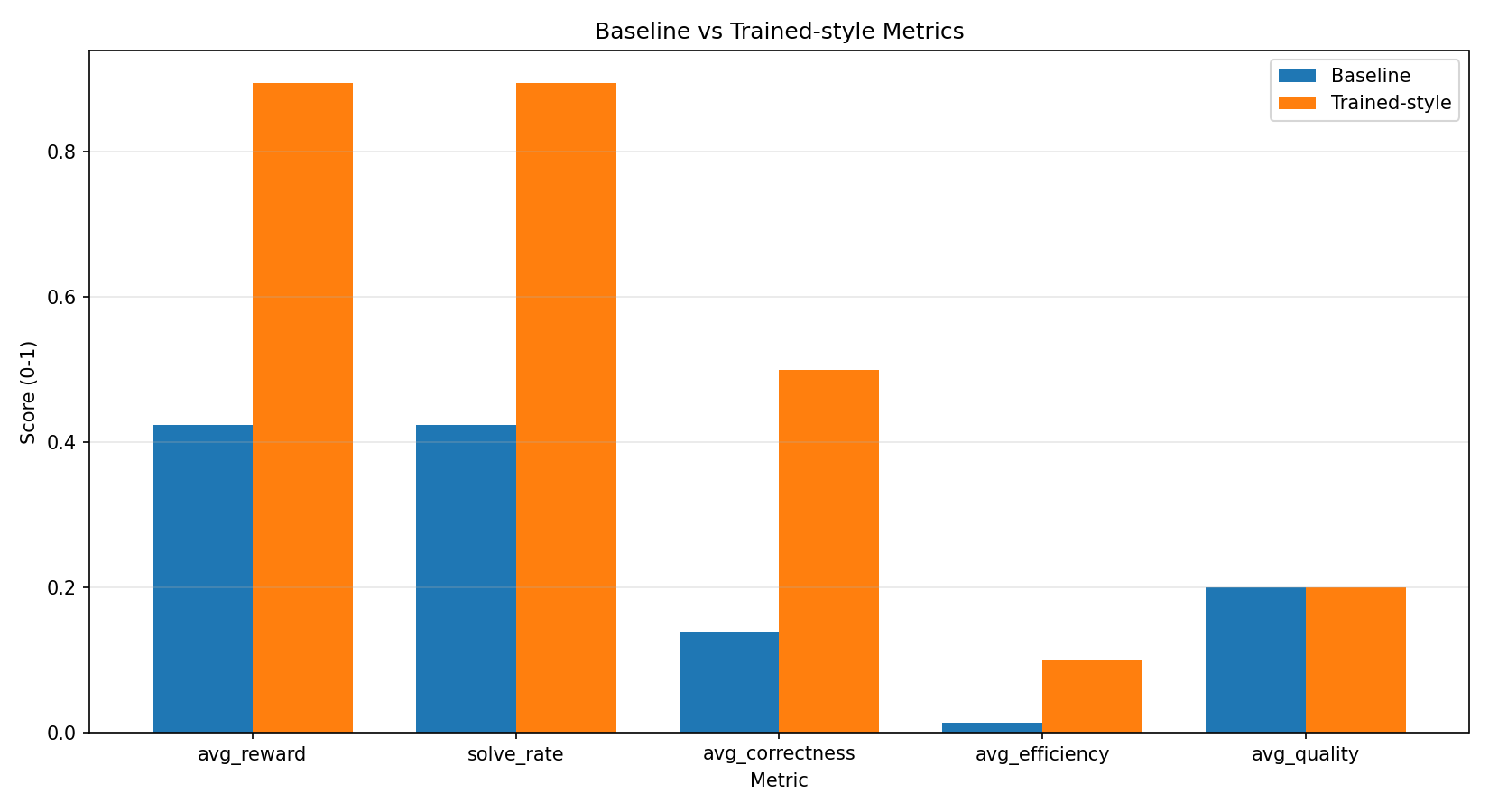 Side-by-side comparison of all metrics.
Validate OpenEnv package:
cd envs/incident_triage
openenv validate --verbose
Run local benchmark harness:
python -m src.training.train_grpo --episodes 40 --output artifacts/training_metrics.jsonl
python -m src.training.export_submission_artifacts
Run unit tests:
python -m unittest discover -s tests -p "test_openenv_incident_triage.py"adaptive-meta-env/
├── envs/incident_triage/ # Seed environment (OpenEnv-compliant)
├── generated_envs/ # Environments auto-generated by Designer Agent
├── src/
│ ├── designer/ # Designer Agent + prompt templates
│ ├── validator/ # Sandbox validation harness
│ ├── curriculum/ # ECI escalation controller
│ └── training/ # GRPO training loop
├── prompts/ # System prompts (designer, solver, curriculum)
├── notebooks/ # Colab training notebook
├── artifacts/
│ ├── plots/ # Training curves
│ ├── metrics/ # submission_summary.json
│ └── writeup/ # Blog + short writeup
└── Dockerfile
User: "Train an agent to diagnose degraded production services"
          │
          ▼
    Designer Agent
    (generates OpenEnv-compliant environment code)
          │
          ▼
    Sandbox Validator
    (runs dummy agent for 10 steps, checks API contracts)
    fails? ──► sends traceback back to Designer to self-correct
          │
          ▼
    OpenEnv Server
    (serves reset / step / state)
          │
          ▼
    GRPO Training Loop (Unsloth + TRL)
    (solver agent trains on the environment)
          │
    solve_rate > 90%?
          │ yes
          ▼
    Curriculum Controller
    (Designer escalates ECI: adds noise, confounders, hidden constraints)
          │
          └──► loop continues at higher difficulty
OpenEnv · TRL · Unsloth · GRPO · Weights & Biases · Hugging Face Spaces · Docker · FastAPI
- OpenEnv dependency is tracked via GitHub main in
envs/incident_triage/pyproject.toml. - Large media files are intentionally excluded;