Deterministic path identity across runtimes. Root-bound filesystem access where real I/O begins.
English | Language coverage | Targets | Verification | Security


Path+FS = authoritative root-bound filesystem boundary; Path+Client = lexical identity plus daemon/client helpers; Transport = daemon wrapper only; Path only = lexical identity only.
Every runtime has a path library. CanonicalPath is for the moment where a path leaves one runtime and enters another.
A Unity editor tool may pass a path to a TypeScript MCP gateway, a Go daemon, a PowerShell script, a browser UI, WSL, Windows, and back again. Each layer can interpret .., slashes, drive-relative paths, UNC paths, symlinks, device names, and missing files differently. That is how path bugs become security bugs, broken artifacts, and hard-to-debug agent behavior.
The key idea:
CanonicalPathsays what path identity the tool means.CanonicalFSdecides whether real filesystem I/O may touch that path under a root.- Non-Go runtimes share lexical identity and delegate security-sensitive I/O to the Go daemon.
| Layer | Purpose | Filesystem access | Security claim |
|---|---|---|---|
CanonicalPath |
Deterministic lexical identity, comparison, serialization, aliases, and shared test vectors. | No | Stable identity contract, not an I/O boundary. |
CanonicalFS |
Root-bound filesystem access for real reads/writes. | Yes | Go implementation is the authoritative filesystem security boundary. |
| Go daemon | Capability-style HTTP/RPC boundary for non-Go clients. | Yes | Other languages delegate security-sensitive I/O to this daemon. |
| Client/runtime ports | Lexical helpers, wrappers, transports, Unity bridge adapters. | Usually no | Lexical/client-only unless explicitly documented otherwise. |
The split is intentional: path identity is not file access.
Use standard libraries for ordinary local path manipulation. Use CanonicalPath when a path must cross process, language, operating-system, editor, or agent boundaries without changing meaning.
CanonicalPath is designed for:
- agent tools and MCP servers that must validate scoped paths before touching a project;
- build systems and generators that reference files before they exist;
- Unity/editor pipelines that need scoped paths such as
Assets/...,Packages/..., artifacts, caches, and temp sessions; - Windows/WSL/macOS/Linux workflows where host paths and project-relative paths are not the same thing;
- archive extraction and file tools where untrusted filenames must not escape a root;
- shared test vectors so Go, TypeScript, JavaScript, Python, Dart, C#, Swift, Kotlin, C, Rust, C++, Haxe, GDScript, PowerShell, Unity, and wrappers stay aligned.
| Group | Current surface | Filesystem security boundary |
|---|---|---|
| Go | canonicalpath, authoritative canonicalfs, daemon |
Yes: Go CanonicalFS / daemon |
| TypeScript | canonicalpath, best-effort canonicalfs helpers, RPC/HTTP clients |
Delegates to Go daemon for adversarial I/O |
| JavaScript standalone/browser | lexical canonicalpath |
No filesystem access |
| PowerShell 5.1 / 7 | lexical module, typed HTTP client helpers, daemon transport | Delegates to Go daemon |
| Bash / Windows CMD-BAT | daemon transport wrappers | Delegates to Go daemon |
| Unity C# | managed lexical helpers, PathGuard/scoped validation, daemon transport, Burst-oriented surface | Delegates to Go daemon |
| Python, Dart/Flutter, C#/.NET, Swift, Kotlin, C, Rust, C++, Haxe, GDScript/Godot | vector-checked lexical canonicalpath surfaces |
Lexical/client-only until native root-bound FS or daemon transport is reviewed |
See docs/language-coverage.md and docs/language-targets.md for the detailed matrix.
For security-sensitive filesystem operations, do not build paths with string concatenation, Join, normalize, or realpath and then open them later.
Use the root-bound filesystem layer:
- In Go, use
CanonicalFSdirectly. - In TypeScript, Unity, C#, Python, PowerShell, Bash, CMD/BAT, or other runtimes, validate and serialize with the local CanonicalPath surface, then delegate real I/O to the Go daemon unless that runtime has a separately reviewed root-bound implementation.
- Path traversal through
.., absolute paths, encoded separators, or mixed separators. - Windows-specific surprises: drive-relative paths like
C:foo, UNC paths, reserved device names, alternate data streams, trailing dots/spaces, and NUL bytes. - Symlink and reparse-point escape from a trusted project root.
- Time-of-check/time-of-use bugs from validating a path string and opening it later.
- Zip Slip style archive writes outside the destination directory.
- Agent/MCP tools writing into the wrong project, cache, artifact, package, or temp root.
- Broken identity when one runtime stores a path and another runtime interprets it differently.
- Canonical repository:
https://github.com/romanilyin/canonicalpath. - TypeScript/npm package:
@romanilyin/canonicalpath. - JavaScript standalone npm package:
@romanilyin/canonicalpath-standalone. - Go module:
github.com/romanilyin/canonicalpath/packages/go. - Unity UPM package:
com.romanilyin.canonicalpath. - Unity npmjs scoped-registry release candidate:
com.romanilyin.canonicalpath@2026.5.24-1. - Release version:
2026.5.18-2. - License:
LicenseRef-Stinger-Royalty-Free-EULA-1.0.
The full source release plan is tracked in docs/release-2026.5.18-2.md; Unity registry publication is tracked in docs/release-unity-2026.5.24-1.md. The Go module tag is packages/go/v0.2026.5-18.2; see docs/release-process.md for the release tag policy.
- Planned language targets and allocation-check gates are tracked in
spec/language-targets.jsonand summarized indocs/language-targets.md. - Planned package directories are skeleton/not implemented placeholders unless listed as supported or as an early bridge target.
- Go
canonicalfs.Renameis intentionally unsupported on Go 1.24 becauseos.Rootdoes not expose a root-bound rename method there. Do not replace it withfilepath.Join(root, rel)plusos.Rename.
After installing dependencies, run:
pnpm install
pnpm verify
For Go race-sensitive filesystem tests, also run:
pnpm go:raceFor active allocation and memory smoke gates, run:
pnpm allocIf the pnpm shim is not available, use corepack pnpm for the same commands. Detailed verification commands live in docs/verification.md.
CanonicalPath is not meant to replace normal path utilities for simple, trusted, single-language applications.
You probably do not need it if:
- paths never cross a language/process/OS boundary;
- filenames are fully trusted and intentionally allowed to point anywhere;
- you only need local display formatting;
- your OS sandbox/container already handles the security boundary and you do not need cross-runtime identity.
This is not an attempt to invent a universal filesystem standard. It is a practical contract for codebases where path strings are already crossing too many boundaries.
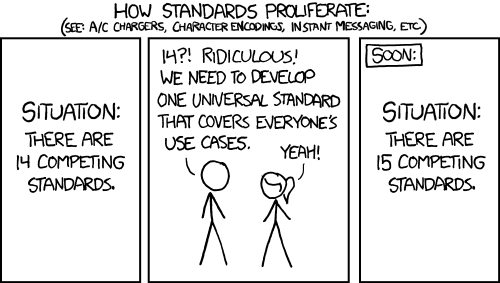
Image: xkcd “Standards”. The point is taken seriously: CanonicalPath should be used as a narrow contract at tool boundaries, not as a reason to rewrite every path helper in every program.
This project is licensed under Stinger Royalty-Free EULA 1.0.
- Authoritative version: Russian text in
LICENSE.ru.md. - English convenience text:
LICENSE.md, provided for readability. - SPDX identifier:
LicenseRef-Stinger-Royalty-Free-EULA-1.0. - Licensor: ROMAN ILYIN.
- Canonical repository: https://github.com/romanilyin/canonicalpath.
Free for personal, internal, open, and commercial End Products. Royalty-free. Attribution and the Canonical Repository notice must be preserved. Standalone sale, resale, paid redistribution, or standalone commercialization of this Asset or Derivative Assets is prohibited.
The Russian EULA is the primary and controlling version. If the Russian and English versions conflict, differ, or are interpreted differently, the Russian version controls.
See LICENSE.md for the English convenience text, LICENSE.ru.md for the authoritative Russian text, and NOTICE.md for project-specific notices.