A GPU-accelerated WebGPU implementation of the Gray-Scott reaction-diffusion system, capable of generating complex spatial patterns from simple chemical interactions. Compiles to WebAssembly for near-native browser performance.
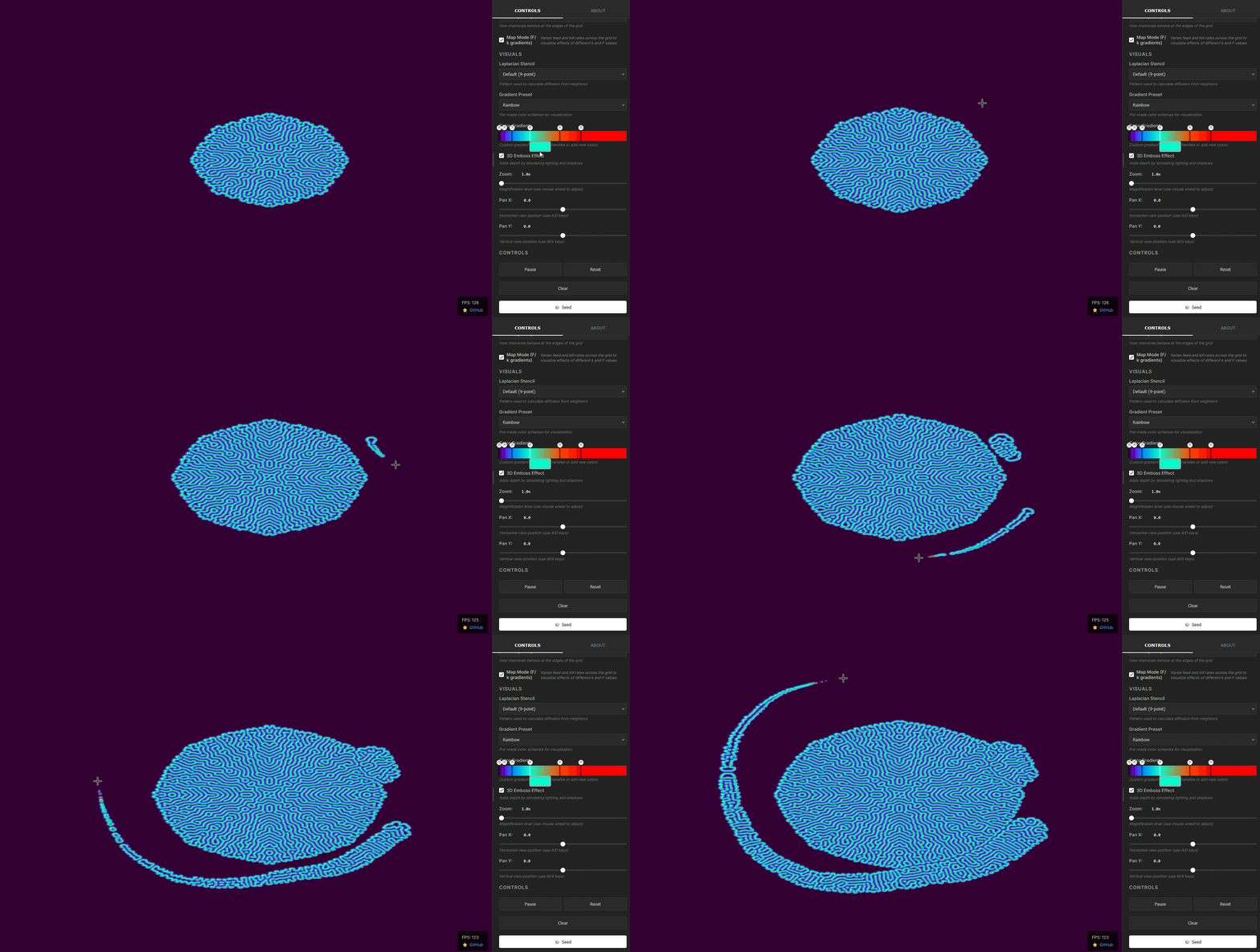
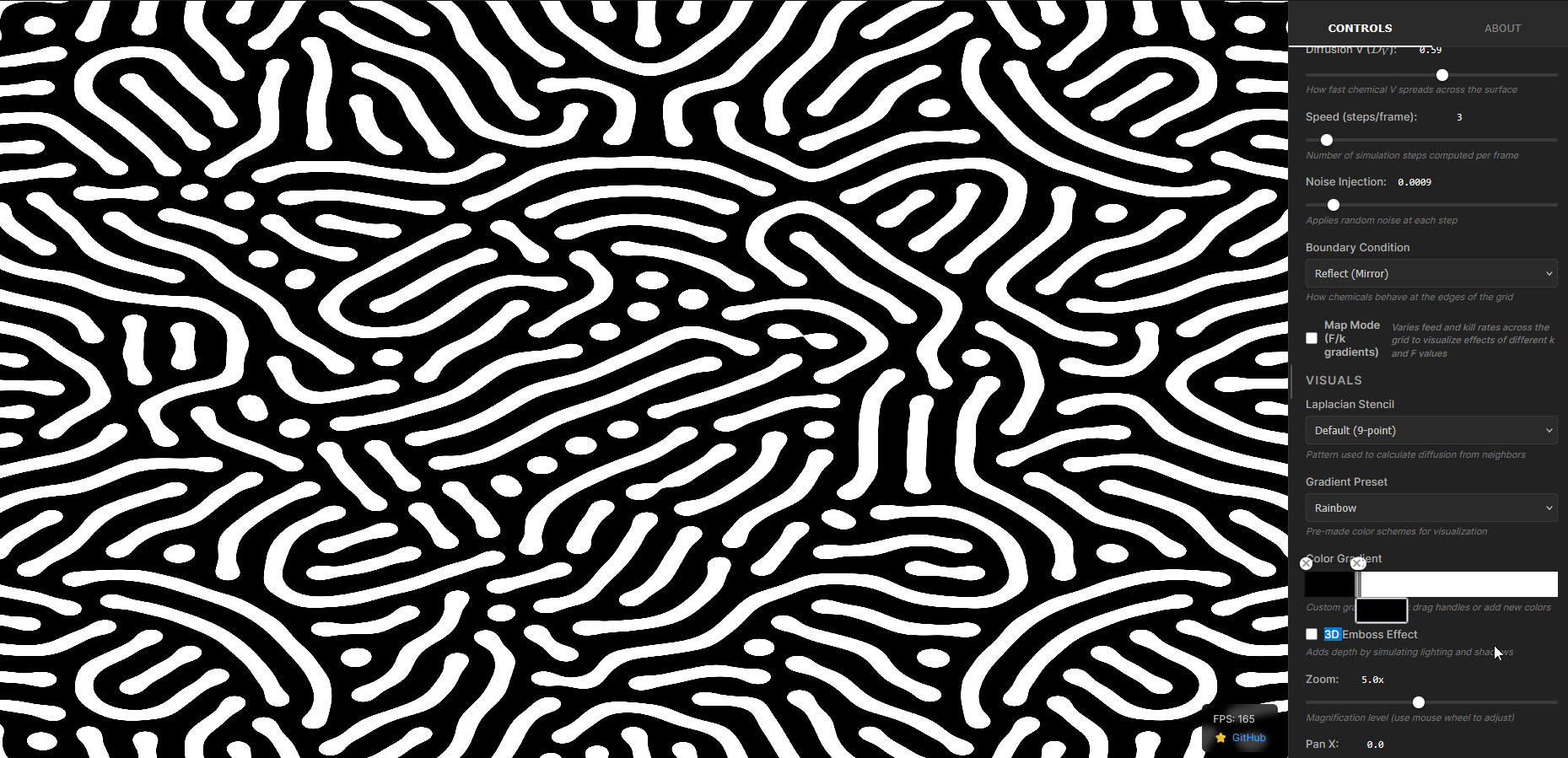
The Gray–Scott model is a reaction–diffusion system used to look at how simple chemical interactions can generate complex patterns. It describes the evolution of two chemical species, U and V, diffusing across a surface while undergoing an autocatalytic reaction. Unlike linear diffusion equations, which smooth out disturbances, the Gray–Scott system is highly nonlinear and can produce stable spots, stripes, waves, and other very interesting Turing patterns.
Because of its non-linear nature, we must simulate the system numerically. Here, we simulate it on a 2D grid using finite difference approximations for the diffusion terms and explicit time-stepping for the reactions. Almost like a cellular automaton, but instead of having discrete states, each cell holds continuous concentration values for chemicals U and V.
The Gray–Scott system models a simplified autocatalytic reaction:
- U + 2V → 3V (autocatalysis)
- V → P (decay)
Here, U is fed into the system at a constant rate, while V is the reactant that autocatalytically converts U into more of itself. Because of these interactions, small changes in the concentrations of U and V can grow and lead to complex patterns.
When diffusion is included and the system is treated as a continuous 2D medium, the concentrations U(x,y,t) and V(x,y,t)—meaning 'the concentration of U or V at position (x,y) and time t'—evolve according to the following pair of partial differential equations:
Where:
- DU and DV are the diffusion rates of species U and V
- F is the feed rate of U
- k is the kill rate of V
-
$\nabla^2$ is the Laplacian operator, which captures how the concentration at a point differs from its neighbors
We compute the new concentration of U and V at each grid cell (i,j) by taking the current concentration, adding the effects of diffusion (via the Laplacian), the reaction term, and the feed/kill terms, and then just scale it up by a small time step Δt for every iteration. Each grid point depends only on its immediate neighbors, so the computation is highly parallelizable. This simulation uses GPU acceleration via WebGPU compute shaders to efficiently compute the updates for all grid cells simultaneously. Neat!
This project has been an amazing opportunity to learn all about GPU programming, shaders, webassembly, and numerical simulation. In the end, I was able to create a real-time interactive simulation that runs entirely in the browser. It's been a lot of fun to play with, and I've spent hours just messing around with the parameters to see the different patterns that emerge.
- Built with Rust and WebGPU via
wgpu - Compiled to WebAssembly for browser execution
- Uses compute shaders for parallel simulation
- Real-time gradient updates and visual effects
- Rust
- wasm-pack
- A modern web browser
# Install wasm-pack if needed
cargo install wasm-pack

# Build the WebAssembly module
wasm-pack build --target web

# Serve locally (use any static file server---whatever)
python -m http.server 8000
Then open http://localhost:8000 in browser that supports WebGPU.
- Reaction-Diffusion by the Gray-Scott Model: Pearson's Parametrization
- Karl Sims' Reaction-Diffusion Tutorial
- Learn Wgpu
This project is open source and available under the MIT License.