| Branch | Version | Status |
|---|---|---|
master |
 |
 |
develop |
 |
 |
| Platform | Rust | Python |
|---|---|---|
| Linux (x86_64) | TBA |
3.8+ |
| macOS (x86_64) | TBA |
3.8+ |
| Windows (x86_64) | TBA |
3.8+ |
- Website: https://nautilustrader.io
- Docs: https://docs.nautilustrader.io
- Support: support@nautilustrader.io
NautilusTrader is an open-source, high-performance, production-grade algorithmic trading platform, providing quantitative traders with the ability to backtest portfolios of automated trading strategies on historical data with an event-driven engine, and also deploy those same strategies live.
The platform is 'AI-first', designed to deploy models for algorithmic trading strategies developed using the Python ecosystem - within a highly performant and robust Python native environment. This helps to address the challenge of keeping the research/backtest environment consistent with the production live trading environment.
NautilusTraders design, architecture and implementation philosophy holds software correctness and safety at the highest level, with the aim of supporting Python native, mission-critical, trading system backtesting and live deployment workloads.
The platform is also universal and asset class agnostic - with any REST, WebSocket or FIX API able to be integrated via modular adapters. Thus, it can handle high-frequency trading operations for any asset classes including FX, Equities, Futures, Options, CFDs, Crypto and Betting - across multiple venues simultaneously.
- Fast: C-level speed through Cython. Asynchronous networking with
uvloop. - Reliable: Type safety through Cython. Redis backed performant state persistence.
- Flexible: OS independent, runs on Linux, macOS, Windows. Deploy using Docker.
- Integrated: Modular adapters mean any REST, WebSocket, or FIX API can be integrated.
- Advanced: Time-in-force options
GTD,IOC,FOKetc, advanced order types and triggers,post-only,reduce-only, and icebergs. Contingency order lists includingOCO,OTOetc. - Backtesting: Run with multiple venues, instruments and strategies simultaneously using historical quote tick, trade tick, bar, order book and custom data with nanosecond resolution.
- Live: Use identical strategy implementations between backtesting and live deployments.
- Multi-venue: Multiple venue capabilities facilitate market making and statistical arbitrage strategies.
- AI Agent Training: Backtest engine fast enough to be used to train AI trading agents (RL/ES).
- Distributed: Run backtests synchronously or as a graph distributed across a
daskcluster.

nautilus - from ancient Greek 'sailor' and naus 'ship'.
The nautilus shell consists of modular chambers with a growth factor which approximates a logarithmic spiral. The idea is that this can be translated to the aesthetics of design and architecture.
Traditionally, trading strategy research and backtesting might be conducted in Python (or other suitable language), with the models and/or strategies then needing to be reimplemented in C, C++, C#, Java or other statically typed language(s). The reasoning here is to utilize the performance and type safety a compiled language can offer, which has historically made these languages more suitable for large trading systems.
The value of NautilusTrader here is that this reimplementation step is circumvented - as the critical core components of the platform have all been written entirely in Cython. Because Cython can generate efficient C code (which then compiles to C extension modules as native binaries), Python can effectively be used as a high-performance systems programming language - with the benefit being that a Python native environment can be offered which is suitable for professional quantitative traders and trading firms.
Python was originally created decades ago as a simple scripting language with a clean straight forward syntax. It has since evolved into a fully fledged general purpose object-oriented programming language. Based on the TIOBE index, Python is currently the most popular programming language in the world. Not only that, Python has become the de facto lingua franca of data science, machine learning, and artificial intelligence.
The language out of the box is not without its drawbacks however, especially in the context of implementing large performance-critical systems. Cython has addressed a lot of these issues, offering all the advantages of a statically typed language, embedded into Pythons rich ecosystem of software libraries and developer/user communities.
Cython is a compiled programming language which aims to be a superset of the Python programming language, designed to give C-like performance with code that is written in Python - with optional C-inspired syntax.
The project heavily utilizes Cython to provide static type safety and increased performance for Python through C extension modules. The vast majority of the production code is actually written in Cython, however the libraries can be accessed from both pure Python and Cython.
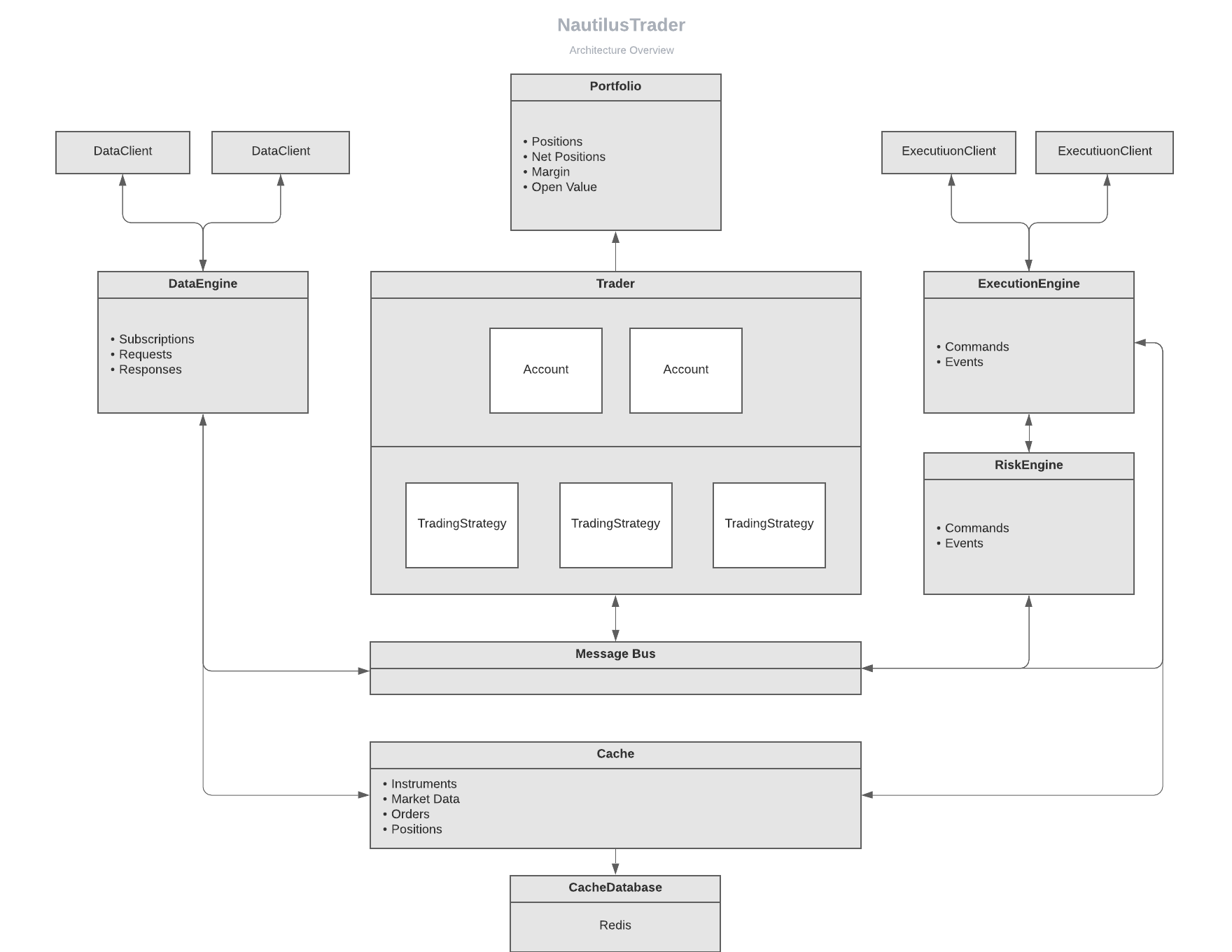
- Reliability
- Performance
- Modularity
- Testability
- Maintainability
- Deployability
NautilusTrader is designed in a modular way to work with 'adapters' which provide connectivity to data publishers and/or trading venues - converting their raw API into a unified interface. The following integrations are currently supported:
| Name | ID | Type | Status | Docs |
|---|---|---|---|---|
| Betfair | BETFAIR | Sports Betting Exchange |  |
Guide |
| Binance | BINANCE | Crypto Exchange | |
Guide |
| Binance US | BINANCE | Crypto Exchange | |
Guide |
| FTX | FTX | Crypto Exchange | |
Guide |
| FTX US | FTX | Crypto Exchange | |
Guide |
| Interactive Brokers | IB | Brokerage (multi-venue) |  |
Guide |
Refer to the Integrations documentation for further details.
We recommend running the platform with the latest stable version of Python, and in a virtual environment to isolate the dependencies.
To install the latest binary wheel from PyPI:
pip install -U nautilus_trader
To install on ARM architectures such as MacBook Pro M1 / Apple Silicon, this stackoverflow thread is useful: https://stackoverflow.com/questions/65745683/how-to-install-scipy-on-apple-silicon-arm-m1
Refer to the Installation Guide for other options and further details.
NautilusTrader is currently following a bi-weekly beta release schedule. The API is becoming more stable, however breaking changes are still possible between releases. Documentation of these changes in the release notes are made on a best-effort basis.
The master branch will always reflect the source code for the latest released version.
The develop branch is normally very active with frequent commits, we aim to maintain a stable
passing build on this branch.
The current roadmap has a goal of achieving a stable API for a 2.x version. From this
point we will follow a more formal process for releases, with deprecation periods for any API changes.
A Makefile is provided to automate most installation and build tasks. It provides the following targets:
make install-- Installs the package using poetry.make build-- Runs the Cython build script.make clean-- Cleans all none source artifacts from the repository.make docs-- Builds the documentation HTML using Sphinx.make pre-commit-- Runs the pre-commit checks over all files.
Indicators and strategies can be developed in both Python and Cython (although if performance and latency sensitivity is import we recommend Cython). The below are some examples of this:
- indicator example written in Python.
- indicator examples written in Cython.
- strategy examples written in both Python and Cython.
- backtest examples using a
BacktestEnginedirectly.
Binder can launch Jupyter Notebooks from source repositories. You can access a complete running backtest example through Binder here! Please note that currently Binder needs to build the platform from scratch which can take a significant amount of time. We are working to optimize this.

The following is a minimal EMA Cross strategy example which just uses bar data.
While trading strategies can become very advanced with this platform, it's still possible to put
together simple strategies. First inherit from the TradingStrategy base class, then only the
methods which are required by the strategy need to be implemented.
class EMACross(TradingStrategy):
    """
    A simple moving average cross example strategy.

    When the fast EMA crosses the slow EMA then enter a position at the market
    in that direction.

    Cancels all orders and flattens all positions on stop.
    """

    def __init__(self, config: EMACrossConfig):
        super().__init__(config)

        # Configuration
        self.instrument_id = InstrumentId.from_str(config.instrument_id)
        self.bar_type = BarType.from_str(config.bar_type)
        self.trade_size = Decimal(config.trade_size)

        # Create the indicators for the strategy
        self.fast_ema = ExponentialMovingAverage(config.fast_ema_period)
        self.slow_ema = ExponentialMovingAverage(config.slow_ema_period)

        self.instrument: Optional[Instrument] = None  # Initialized in on_start

    def on_start(self):
        """Actions to be performed on strategy start."""
        # Get instrument
        self.instrument = self.cache.instrument(self.instrument_id)

        # Register the indicators for updating
        self.register_indicator_for_bars(self.bar_type, self.fast_ema)
        self.register_indicator_for_bars(self.bar_type, self.slow_ema)

        # Get historical data
        self.request_bars(self.bar_type)

        # Subscribe to live data
        self.subscribe_bars(self.bar_type)

    def on_bar(self, bar: Bar):
        """Actions to be performed when the strategy receives a bar."""
        # BUY LOGIC
        if self.fast_ema.value >= self.slow_ema.value:
            if self.portfolio.is_flat(self.instrument_id):
                self.buy()
            elif self.portfolio.is_net_short(self.instrument_id):
                self.flatten_all_positions(self.instrument_id)
                self.buy()
        # SELL LOGIC
        elif self.fast_ema.value < self.slow_ema.value:
            if self.portfolio.is_flat(self.instrument_id):
                self.sell()
            elif self.portfolio.is_net_long(self.instrument_id):
                self.flatten_all_positions(self.instrument_id)
                self.sell()

    def buy(self):
        """Users simple buy method (example)."""
        order: MarketOrder = self.order_factory.market(
            instrument_id=self.instrument_id,
            order_side=OrderSide.BUY,
            quantity=self.instrument.make_qty(self.trade_size),
        )

        self.submit_order(order)

    def sell(self):
        """Users simple sell method (example)."""
        order: MarketOrder = self.order_factory.market(
            instrument_id=self.instrument_id,
            order_side=OrderSide.SELL,
            quantity=self.instrument.make_qty(self.trade_size),
        )

        self.submit_order(order)

    def on_stop(self):
        """Actions to be performed when the strategy is stopped."""
        # Cleanup orders and positions
        self.cancel_all_orders(self.instrument_id)
        self.flatten_all_positions(self.instrument_id)

        # Unsubscribe from data
        self.unsubscribe_bars(self.bar_type)

    def on_reset(self):
        """Actions to be performed when the strategy is reset."""
        # Reset indicators here
        self.fast_ema.reset()
self.slow_ema.reset()We aim to provide the most pleasant developer experience possible for this hybrid codebase of Python, Cython and Rust. Please refer to the Developer Guide for helpful information.
Involvement from the trading community is a goal for this project, all help is welcome! Developers can open issues on GitHub to discuss proposed enhancements, changes, or to make bug reports. Questions and more general thoughts are best directed to a discussions thread.
Refer to the CONTRIBUTING.md for further information.
Please make all pull requests to the develop branch.
We maintain a Discord server where contributors and active users of NautilusTrader can interact!
NautilusTrader is licensed under the GNU Lesser General Public License v3.0.
Contributors are also required to sign a standard Contributor License Agreement (CLA), which is administered automatically through CLA Assistant.
Copyright (C) 2015-2022 Nautech Systems Pty Ltd. All rights reserved. https://nautechsystems.io