

News
- 2026/11/13: Blog post on Murmur is out.
- 2026/11/04: Preprint v2 is out.
- 2026/06/01: Preprint is released on arXiv.
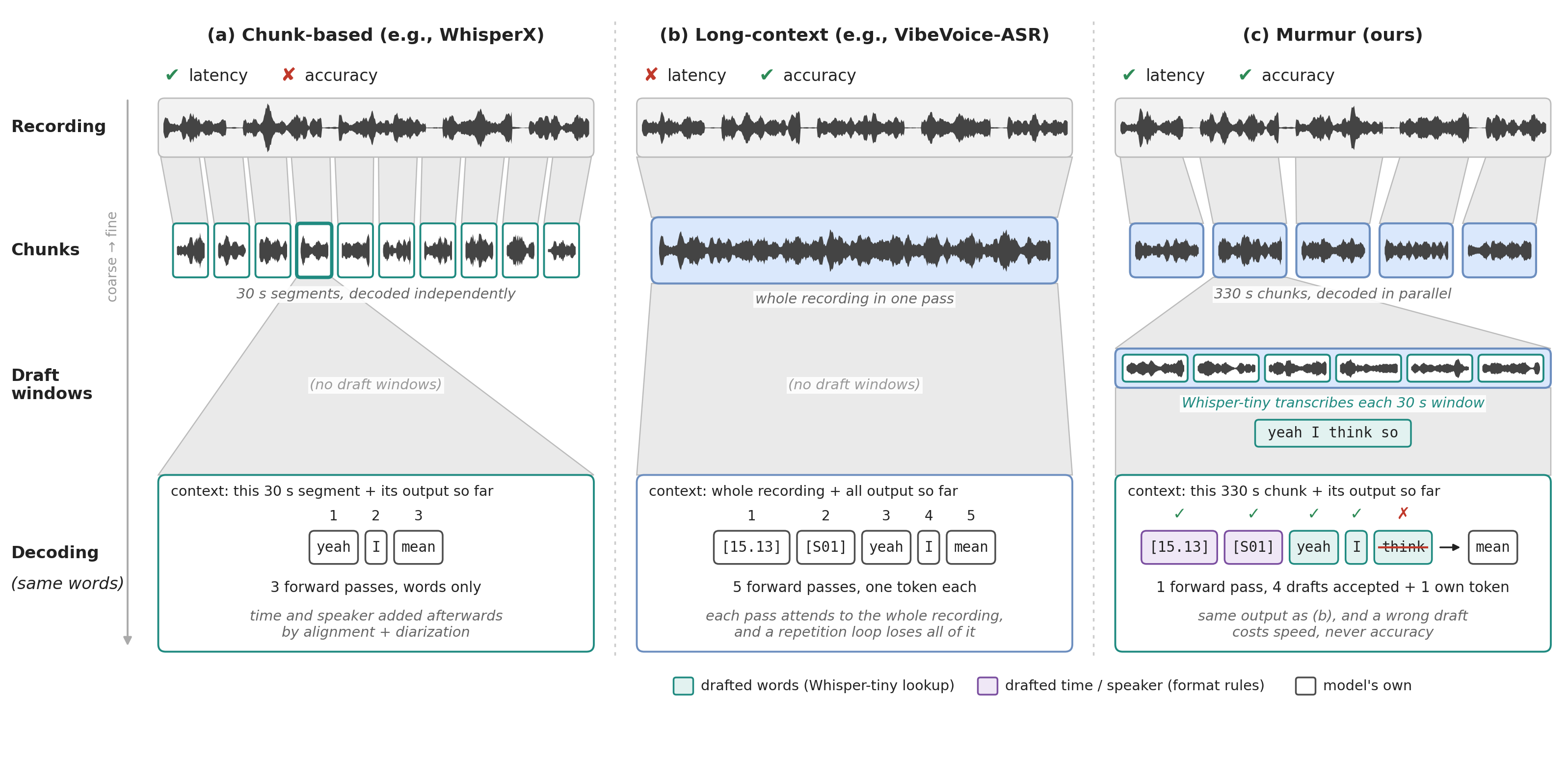
Murmur is an inference system that serves long-context ASR models, such as VibeVoice-ASR and MOSS-Transcribe-Diarize, on long audio. These models transcribe an hour-long recording in a single pass, which is slow and can fail entirely on a repetition loop.
- Across chunks: Murmur decodes ~5-minute target chunks in parallel. This intermediate size gives the model enough context to match single pass in most cases, and a loop costs at most one chunk.
- Within each chunk: hierarchical chunking splits each chunk into 30 s draft windows. A small Whisper model transcribes them, and structure-aware drafting adds the timestamps and speaker tags, giving drafts for speculative decoding. The long-context model verifies every token, so decoding is faster and the output is unchanged.
Overall, Murmur is 2.5x faster than single pass on average (2.0-2.9x), end to end including diarization, and lowers tcpWER by 2.0 points on average.
Single pass, Murmur and WhisperX transcribing the same 32-minute AMI meeting on one H100, replayed at 8x.
murmur_demo.mp4
Murmur against each model's own single pass on four meeting datasets. Each cell is tcpWER / latency per recording (lower is better), on one H100 with vLLM, with latency including diarization.
| Model | System | AMI-IHM | AMI-SDM | AliMeeting | AISHELL-4 |
|---|---|---|---|---|---|
| VibeVoice-ASR | single pass | 30.1% / 109 s | 39.6% / 100 s | 41.7% / 123 s | 30.3% / 111 s |
| Murmur | 24.5% / 38 s | 32.9% / 39 s | 38.7% / 47 s | 30.5% / 46 s | |
| MOSS-Transcribe-Diarize | single pass | 17.5% / 54 s | 29.6% / 77 s | 13.6% / 91 s | 14.1% / 51 s |
| Murmur | 17.3% / 26 s | 22.8% / 26 s | 17.5% / 32 s | 16.6% / 26 s |
Bold: better of single pass and Murmur. WER, cpWER and DER are in the paper. AMI scores use a corrected reference reader (2-6 points lower than earlier arXiv versions).
Murmur runs each model on its own vLLM server and talks to it through a small client class. To
add a model, add a client class in murmur/models/.
Diarizing ASR models write the words, timestamps and speaker labels themselves.
| Model | Murmur.load(...) |
Draft windows | Max audio | Tested on | vLLM server |
|---|---|---|---|---|---|
| VibeVoice-ASR (8.5B) | "vibevoice" |
on | 60 min | English, Mandarin | vLLM 0.14 + VibeVoice plugin |
| MOSS-Transcribe-Diarize (0.9B) | "moss" |
off | 90 min | English, Mandarin | vLLM nightly |
Text-only ASR models write plain text; Murmur adds word times (from the short-window Whisper model) and speakers (from pyannote).
| Model | Murmur.load(...) |
Draft windows | Max audio | Tested on | vLLM server |
|---|---|---|---|---|---|
| Voxtral Mini (3B) | "voxtral" |
on | 30 min | English | vLLM 0.14 |
| Voxtral Small (24B) | "voxtral-small" |
on | 30 min | English | vLLM 0.14 |
A single pass over a model's max audio length is split into the fewest pieces that fit.
The murmur client and each model's vLLM server use separate environments, because the two models
need different vLLM builds.
conda create -n murmur python=3.10 -y && conda activate murmur
pip install "murmur-asr[all]"
# or, from source: git clone https://github.com/uw-syfi/Murmur.git && pip install -e "Murmur[all]"
huggingface-cli login   # accept the terms of pyannote/speaker-diarization-3.1 first
vLLM servers (VibeVoice-ASR, MOSS-Transcribe-Diarize)
# VibeVoice-ASR: vLLM 0.14 + the VibeVoice plugin
conda create -n vibevoice-vllm python=3.10 -y && conda activate vibevoice-vllm
pip install vllm==0.14.0
git clone https://github.com/microsoft/VibeVoice.git && pip install -e VibeVoice
pip install "murmur-asr[server]"

# MOSS-Transcribe-Diarize: vLLM nightly (tested: 0.23.1rc1.dev949)
conda create -n moss-vllm python=3.10 -y && conda activate moss-vllm
pip install -U vllm --pre --extra-index-url https://wheels.vllm.ai/nightly
pip install "murmur-asr[server]"

# so the client can start the servers itself
export MURMUR_VLLM_VIBEVOICE=$CONDA_PREFIX/../vibevoice-vllm/bin/vllm
export MURMUR_VLLM_MOSS=$CONDA_PREFIX/../moss-vllm/bin/vllmMurmur.load starts the model's vLLM server, and transcribe returns segments with speakers and
timestamps.
from murmur import Murmur

with Murmur.load("vibevoice") as m:   # or Murmur.load("moss", language="zh")
    print(m.transcribe("meeting.wav"))  # [  12.40-  15.10] SPEAKER_01: ...
Options, CLI and a separately started server
Murmur.load options: chunk_s (default 330), batch_size (default 8), draft_windows,
language ("en" or "zh"), diarize, gpu. transcribe(..., single_pass=True) runs the
single-pass baseline.
# in the vibevoice-vllm environment
CUDA_VISIBLE_DEVICES=0 murmur serve vibevoice --port 8000 --draft-dir /tmp/murmur_drafts
# in the murmur environment
murmur transcribe meeting.wav --model vibevoice --url http://localhost:8000 --draft-dir /tmp/murmur_drafts
Client and server must share the draft directory (same machine).
From the repository root, create a local Python environment and install the MLX runtime:
uv venv --python 3.12
uv pip install -e . 'moss-transcribe-diarize[mlx-runtime] @ git+https://github.com/vanch007/mlx-MOSS-Transcribe-Diarize.git@d2546316f76e93947e8d99a17fb88652f8ad6ab2'
.venv/bin/murmur transcribe meeting.wav --model moss --backend mlx --no-diarize --json
The first run downloads the unquantized MOSS checkpoint
(about 1.8 GB). To use a downloaded or self-converted directory, pass --checkpoint /path/to/model.
The model stays loaded across files and decodes one chunk at a time. With --no-diarize, MOSS
labels speakers within each chunk. To link speakers across chunks, supply a recording-wide timeline
in Python or install the diarize extra, configure pyannote access as above, and omit --no-diarize.
from murmur import Murmur

with Murmur.load("moss", backend="mlx", diarize=False) as model:
    transcript = model.transcribe("meeting.wav")
    print(transcript.text)
Use --quantization int4 or --quantization int8 to download the existing packed MOSS
checkpoint directly. Python accepts the same values in Murmur.load(..., quantization="int4").
Both checkpoints quantize the text backbone and retain the original audio encoder and VQ adaptor.
.venv/bin/murmur transcribe meeting.wav --model moss --backend mlx --quantization int4 --no-diarizeTo load your own packed checkpoint, pass its local directory or Hugging Face ID via
--checkpoint alone. To quantize explicit unquantized weights in memory, supply both
--checkpoint and --quantization. Other presets quantize the selected weights at load time.
Available presets are affine integers (int1, int2, int3, int4, int5, int6,
int8, group size 64), mxfp4 and mxfp8 (group size 32), and nvfp4 (group size 16).
The 1–3 bit affine presets produced unusable transcripts in a short English smoke test on an M4 Max.
To enable speculative decoding, install the draft dependencies and pass --draft-windows on:
uv pip install -e '.[drafts]'
.venv/bin/murmur transcribe meeting.wav --model moss --backend mlx --draft-windows on --no-diarize --json
In Python, use Murmur.load("moss", backend="mlx", draft_windows=True, diarize=False).
Whisper runs on the CPU and supplies timestamped words to Murmur’s MOSS proposer. The MLX model
checks up to eight proposed tokens per pass. JSON output includes proposed and accepted token counts
and the number of verification passes in stats.speculative. The default for MOSS is greedy decoding.
Use the same chunk size and diarization settings with --draft-windows off for a latency comparison.
--single-pass selects the greedy baseline even when draft windows are enabled.
benchmarks/run.py reproduces the paper's results, one model, dataset and system at a time.
python benchmarks/run.py --model vibevoice --dataset ami_ihm --system murmur --mode latencyDatasets, systems and scoring
bash benchmarks/prepare/download_ami.sh && python benchmarks/prepare/build_ami_sessions.py   # needs lhotse
python benchmarks/prepare/download_alimeeting_refs.py --archives Eval_Ali.tar.gz Test_Ali.tar.gz --raw_dir /tmp/ali   # OpenSLR 119
python benchmarks/prepare/download_aishell4_refs.py --archive test.tar.gz --raw_dir /tmp/aishell4 # OpenSLR 111--system: single, chunked (greedy), murmur (as in the paper; --draft-windows on|off
overrides) or ngram (vLLM prompt lookup). --mode latency reports end-to-end latency per
recording; --mode throughput reports decoding time for a whole dataset. Scoring: WER (CER for
Mandarin) with jiwer, cpWER and tcpWER (5 s collar) with MeetEval, DER with pyannote.metrics.
@article{murmur2026lee,
  title={Murmur: Efficient Long-Context ASR Inference with Hierarchical Chunking},
  author={Lee, Wei-Tzu and Kamahori, Keisuke and Kasikci, Baris},
  journal={arXiv preprint arXiv:2606.01483},
  year={2026},
  url={https://arxiv.org/abs/2606.01483}
}