
Always-on 2D lidar SLAM with named places, as a spatial memory for LLM agents.

English | 中文
readme-en-v4.mp4
An agent (Claude Code) using EvergreenSLAM as the memory of a home robot; 1:44, wall clock and playback speed on screen. Day 1, from an empty map: asked for the balcony, it finds it through one line of its own exploration notes. Day 2, after a night powered off: a new session with no chat history finds the scissors from memory. No teleoperation, no mapping or localization by hand. Full video (3:18): YouTube; details under Experiments.
$ egs here
current places/dock 2.4m
closest places/dock 2.4m frozen; places/kitchen 15.3m frozen
robot 0.48,1.02,-2.72  keyframe 0s  @solve 135
base 0.75 (cover 98%)  since base match 0.0m  match 0.70 (avg 0.70)
An agent asked to fetch a cola from the fridge understands the request but not the home: where the fridge is, how to reach the kitchen, where the cola was last seen. Whatever model is used, it needs a spatial memory: it must be able to remember a place from a command, a sentence or a photo, send the robot back there later, and keep that memory across context compaction, map re-optimization and process restarts. EvergreenSLAM is a 2D lidar SLAM designed around this requirement.
- One mode, no operator. It runs as a background process with no separate mapping and localization modes: it always maps into the current session while localizing against sessions it has already frozen, and a session freezes itself once it has added enough new area and its poses are well constrained.
- Bounded by area, not uptime. Trimming marginalizes what it removes and sparsifies the result to a Chow-Liu tree, and frozen poses are held constant in the optimizer, so that memory and CPU are bounded by the mapped area rather than by uptime.
- Places that keep resolving. A place is an anchor bound to a submap of the pose graph rather
than to coordinates, exposed to the agent as a directory tree plus a small CLI (
egs, also served as MCP tools). - One cheap sensor. A 2D lidar and a CPU; no IMU, wheel odometry, camera or GPU. It has been run on a 215 CNY lidar and an RK3588 board, and on the public 2D datasets.
The scan matching and the submaps follow Cartographer; the lifelong layer above them is the project's own. How it relates to slam_toolbox is under Related work.

The first test platform: a 2D lidar (215 CNY, about 30 USD), an Orange Pi with an RK3588, mecanum wheels, two power banks.
The agent does not know the home. Language is no longer the bottleneck: an agent asked for a cola from the fridge knows what is wanted. What it lacks is the layout. Its memory is text, and a layout described in enough detail to act on takes a lot of context and survives only as long as the context does, compaction included.
Coordinates are fragile. Writing places down as map coordinates does not hold for long. A coordinate goes stale when the map is rebuilt or re-optimized, often without the agent noticing, and means nothing in another map. Every agent on a conventional SLAM would have to keep its own record of where things are and keep that record consistent with the map. What an agent can use is a name that keeps resolving to the same physical spot, plus a place to record what it saw there.
SLAM without an operator. The usual workflow: tune the odometry, calibrate extrinsics and synchronize timestamps, drive around to map, save, switch to localization mode, tune parameters when the environment changes, and rebuild when it changes too much. Vendors usually package this or train their customers. For a newcomer a mistake shows up as ghosting or drift, sometimes only later, and a rebuild means entering every saved station again. Each step needs an operator, and the agent should not have to be one.
The intended use. For example: walk the robot around the home once, saying "this is the kitchen" in the kitchen and "this is the desk" at the desk, and do nothing else about mapping or localization. The next day, "go and check the kitchen" works. The agent notes that the scissors are in the left desk drawer and the apples on the dining table, and days later "where are the scissors?" leads it to the right place. Furniture moves, the map is re-optimized, the robot restarts, and the places still resolve. Fetching the cola then starts from knowing that the fridge is in the kitchen and how to get there, before an arm takes over. The later steps need manipulation and vision; the layer underneath, places that stay valid without anyone maintaining the map, is what this project argues SLAM itself should provide. The demo below covers the memory half of this on a real robot, from an empty map: places learned by exploring, notes written per place, and a place and a thing found again from that memory. Fetching with an arm is not shown.
Lifelong SLAM, but where. Underneath this is lifelong SLAM: always on, mapping while in use, following changes, with resources that do not grow with uptime. The research literature on it is long, yet to the author's knowledge few open-source 2D implementations can be used as they are; slam_toolbox's lifelong node is described by its README as highly experimental and removes nodes without marginalizing them (see Related work).
Cost. The memory should be cheap enough to leave running on a small robot all day. A 3D lidar costs a few hundred dollars and up and needs a board that can keep up with it. Cameras are cheap, but dense or learned visual SLAM usually wants more compute than a small board has, and cameras degrade in darkness, on textureless walls and under changing illumination. A 2D lidar costs about 30 dollars, needs no GPU, and is insensitive to lighting; its own failure cases (glass, mirrors, strong sunlight) are not addressed here. On the same grounds the pipeline fuses no IMU, wheel odometry or camera: each adds calibration, time synchronization, a driver and per-robot tuning. The cost is that motion prediction comes from the laser alone, a Kalman filter with a Singer motion model fed only by scan matching, which is expected to struggle on fast turns and in long featureless stretches. The position taken is that cheap geometry with sparse semantics attached to named places (for example, a vision-language model occasionally writing "the bin is here") is for this setting a better trade-off than dense visual SLAM.

pixi run -e ros demo: Cartographer's public revo_lds bag (a Neato Revo LDS, 16 min of
driving) replayed at 8x in the browser debug view. Sessions #0 and #1 freeze in turn and #2 starts
mapping.
Mapping is organized in sessions. The frontend always maps into the current session; the backend closes loops against every finished submap within reach, frozen or not, including the current session's own, which the rolling window below keeps recent. Under gradual environmental change the robot therefore keeps matching the world as it is now, and those recent submaps are in turn constrained to the frozen base.
The first session becomes the frozen base once it has a finished submap. A later session is
judged only after it has added enough new area outside the frozen footprint and has stopped
growing; it freezes when it is linked to a frozen session and the marginal standard deviations
of every finished submap pose are below per-axis thresholds. Freezing makes the session's files immutable and its poses
constant in every later optimization. A session that only revisits known space is never frozen
automatically (egs session freeze --yes does it by hand); any unfrozen session is discarded
after more than five boots without being fed (configurable). Where sessions overlap, the composed map keeps the more confident cell.
Consequently a change inside already-mapped ground is visible while the current session is alive
but is not frozen in; re-freezing a changed room is planned, not implemented.
egs init-pose (a pose or a saved place) and egs relocalize match the newest scan of the current
session against the finished submaps of the other sessions: with a pose, the submaps reaching
within 2 m of it, over ±0.5 rad; without one, every submap over every heading, by branch and bound
on each. A match becomes a loop-closure constraint only above the usual score threshold. A session
not yet linked to a frozen one has no position worth keeping, so when no constraint is added it is
moved as a whole onto the best match scoring at least 0.2, or else onto the given pose. It stays
unlinked until a later loop closure passes the usual threshold, and egs reports the outcome as
reseeded. A session already linked to the base is never moved this way.
Two mechanisms keep the graph from growing with uptime.
Trimming with sparsification. The live session keeps a rolling window of its own submaps over ground it re-covers: an older submap is removed once newer submaps cover its area or newer passes cover its track. Removal is a marginalization, not a deletion: the removed nodes' Markov blanket is taken, the joint covariance of the survivors is computed, and the resulting dense information is sparsified to a Chow-Liu tree (the maximum spanning tree over pairwise mutual information) whose edges replace the removed constraints; edges that would span too far become priors weighted by the marginal covariance. At freeze, finished submaps that lie mostly inside the frozen map are dropped the same way, keeping one if all qualify.
Frozen sessions are constant. Frozen poses are parameter blocks held constant in the Ceres problem, no constraint is built between two frozen submaps, and frozen submaps are never modified. The optimization therefore scales with the live session, not with the whole map, and the frozen part grows linearly with mapped area. A simulated 30-loop run stays bounded. On the robot it has run in one flat over several days, but memory and graph size were not logged then; the numbers will be added.

The browser debug view during a long run: four sessions, three of them frozen.
A saved place is an anchor: a submap of the pose graph plus a transform relative to it. When the
graph is re-optimized the place moves with its submap; after a restart the name still resolves.
Anchors survive loop closure, trimming, freezing, restart and an interrupted write, and are what
egs where resolves.
memory/places/kitchen/table/apple is a thing inside a place. The agent works on the tree with
ls, cat, mv and grep. Only what the live process alone knows, such as poses, saving a place,
and map or session management, goes through egs. Keep-out zones, notes and per-place skills live
in the same tree. egs view here renders the current scan over the map around the robot so the
agent can judge for itself whether localization is drifting.
Pure 2D, all double, poses as Eigen::Affine2d. Laser odometry with a correlative matcher and a
Ceres refinement, submaps as probability grids, a pose graph with branch-and-bound loop closure and
Ceres optimization, then session-aware trimming, freezing and persistence with atomic commits.
core/ has no ROS dependency; ROS 2 is one adapter.

The platform the agent demo ran on: an XLeRobot (three omni wheels, a head camera on a pan/tilt neck, two SO-101 arms, not used) with the same 2D lidar as the car above and an RK3588 board. EvergreenSLAM uses only the lidar and the board.
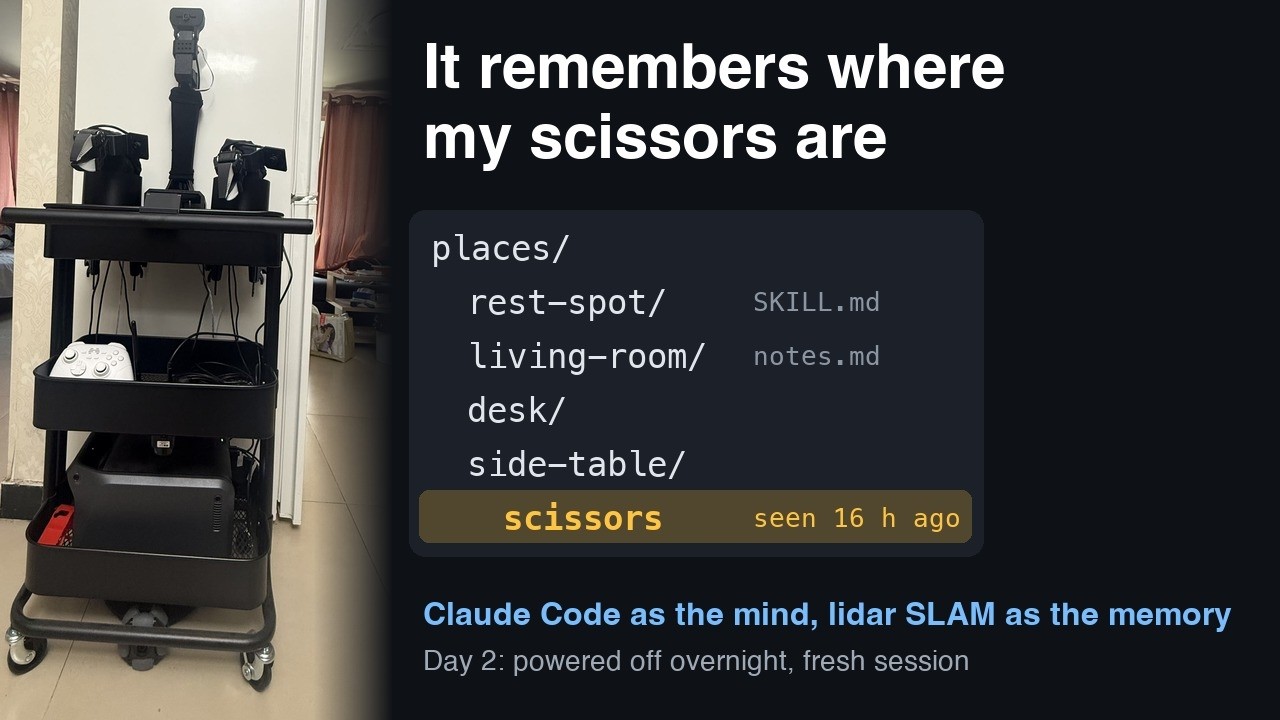
Full video (3:18, English subtitles) on YouTube.
The task.
In the demo, Claude Code (Opus 5.5) acted as the mind of the robot shown above in two sessions: 24
minutes on 2026-10-31 and 4 minutes the next morning. A robot harness that is not part of this
repository (private for now) gave it the body over MCP: speech recognition, following a person, Nav2
navigation to a pose or a saved place, the head, camera snapshots, a lidar scan, and Telegram for
replies and photos. egs from this repository was its only spatial memory.
Day 1 started on purpose from a new map and an empty memory/, so it shows how an agent builds and
uses the memory. On the next morning the robot was restarted (with nobody attending to localization)
and a new agent session began, which shows memory across a restart and across sessions; for longer
SLAM runs see Sessions and freezing and Bounded growth. The person spoke Chinese throughout; the
agent reasoned and wrote its notes in English, with Chinese names of places as aliases.
In fact this take did not go smoothly: the vision service dropped out midway, exploration missed the table the scissors were on, and the agent asked me four times; after my hint ("scissors are usually on a table") it went to ground the map showed as not yet explored and found them there. In the two earlier runs exploration had passed that table, and a single "find the scissors for me" was enough, in about two minutes. Results still depend heavily on the model and on the design of the harness.
Step by step (times as shown at the top left of the video):
- Start (17:03).
egs root,egs fs cat README.md,egs here,egs fs tree places: a new map, no places. - One named place (17:03–17:06). "Follow me", then "your rest spot is beside the fridge";
after a few corrections by voice,
egs place save places/rest-spot, with anode.yamlof aliases and anotes.mdthat records the place as told by the person. This is the only place the person named. - Exploring alone (17:06–17:12). Asked to explore, the agent picks unexplored ground from
egs view map, has Nav2 drive there, looks with the head camera, and saves what it finds: a figure shelf, the living room and its sofa, the washing machine, a desk, the bedroom at its doorway. Eachnotes.mdsays what is there and where the knowledge came from: seen, told by the person, or inferred. One line in the living room's notes, from a photo of a corner at 17:08: "a red striped curtain and, past it, a glass door to what looks like a balcony (阳台, inferred)". The balcony was neither visited nor saved. - A rule for a place (17:13). Docking back at the rest spot, Nav2 crept on the last
centimetres; the agent stopped it, finished with short moves of its own, and wrote
places/rest-spot/SKILL.md: how to finish (the fridge square behind, 0.43 to 0.45 m on the lidar's rear sector).egs where places/rest-spotlists that file underread first:. - "Do you know where the scissors are?" (17:12–17:23).
egs find 剪刀andegs fs grep scissorsreturn nothing. The harness's object detector had stopped responding at 17:08; the agent switched to its own reading of full-resolution snapshots after the first timeout and said so when the search began. It went through the candidates it knew of: the desk, the living-room shelf with tape and small parts (saved astool-shelf), the entrance and the bedroom table, saving places on the way and appending each miss to that place'snotes.md. The person spoke four times: "go and look" (to its question), "look somewhere else", one hint ("scissors are usually on a table", which it stored inplaces/notes.mdas a habit told by the person), and "find them yourself". It then went to ground the map showed as occupied but not yet visited, between the living room and the entrance, and found the scissors on a side table:egs place save places/side-table,egs observe places/side-table/scissors --offset …, and a photo at 17:23, about ten minutes after the question. Exploration had not reached that corner. This was the slowest of three scissors searches that day; in the other two the exploration had already passed that table and the search took about two minutes without hints. Here the time went to the four places searched first and to driving, not to the failed vision calls, which returned within about a second each. - "Take a photo of the balcony, then go back to your rest spot" (17:23–17:25).
egs find 阳台finds no match: nothing was named balcony.egs fs grep balconyreturns the inferred line from step 3. The agent drives toplaces/living-room/tool-shelf(saved during the scissors search), turns the head towards the curtain, moves to the opening rather than squeezing past the sofa, savesplaces/balcony(aliases 阳台, 封闭阳台, balcony; its notes say the person named it) and sends the photo at 17:25, 102 s after the request, with no further input. - Back to the rest spot (17:25–17:26), following its own rule: 3 cm off on arrival, a lidar check, 5 cm back.
- The next morning (2026-11-01, 09:39–09:43). The robot had been powered off overnight where
it parked. After boot, with no
egs init-poseoregs relocalize,egs herereported it atplaces/rest-spot(0.0 m), with a base-map agreement of 0.73 over 90 % cover. A new Claude Code session with no chat history received a four-line prompt: read the same three skills and use only the memory inegs. (Claude Code also loaded the harness's project instructions, which name finding scissors as a target task but do not say where anything is.) The person typed "do you remember where the scissors are? take a photo for me".egs find 剪刀returnedplaces/side-table/scissors, last seen 16 h earlier; the agent said it would check rather than rely on the old observation, took the approach pose fromegs whereand drove there (12 s). The object detector was not running, so it pointed the head along the stored offset, judged the snapshot itself, sent the photo 44 s after the question reached it (the message had waited 46 s in Claude Code's input queue while alistencall ran), and appended a newseenobservation withegs observe. Asked to go back to the rest spot, it followed theplaces/rest-spot/SKILL.mdit had written the day before: 0.49 m from the fridge against the rule's 0.43–0.45 m, then a short reverse. This is one restart of a robot that was not moved while off; it is not a test of relocalization after the robot is carried elsewhere.
At the end of day 1 memory/ held 12 places, one thing (the scissors, with the observation), one
place rule and one home-wide note, all as plain files. On day 2 the agent wrote one observation and
nothing else.
egs answered where places are (where gives the pose and the approach pose the harness passes to
Nav2), bound saved places to the pose graph, and held the files (fs, find, observe, view).
Driving, obstacle avoidance and docking were Nav2 and the harness; hearing, the camera, recognizing
things in photos and every decision were the agent with the harness's tools. The day-1 prompt
asked the agent to read three skills (evergreenslam from this repository, and two harness skills
on moving the robot and on what to remember: provenance tags, place rules in SKILL.md, recording
where something was not found), to narrate each decision, not to force narrow passages, and to
store requested photos in memory. The gamepad stayed with the person as an emergency stop; the
robot's daemon log shows no teleoperation lease during either session.
On 2026-09-29, on an earlier test car (mecanum wheels, a 2D lidar, an RK3588 board), Claude Code
was sent to "check whether anything changed in the kitchen". It read the kitchen's SKILL.md in
the memory tree (stop at the doorway on top of the ramp), took the approach pose from
egs where places/kitchen/door to Nav2, backed out once when wedged against an air purifier, and
recorded a new object next to the bin with egs observe. That car was the platform of the first
public version (2026-09-30); the robot above replaced it on 2026-10-07 and has run EvergreenSLAM
as its spatial memory since.
This is a preview, not a product. Scope was limited to the core; known omissions follow.
Tested on macOS and Linux: unit tests, simulated-lidar end-to-end tests for the frontend, the scan
matcher and each backend stage (loop closure, trimming, freezing, persistence, relocalization,
anchors). CI runs the core and agent tests on Linux (gcc) and macOS on every push; the
ThreadSanitizer run over the backend tests and the ROS 2 adapter build are by hand. Exercised
on the two robots above and on the public bags: laser odometry, loop closure, multi-session mapping
with automatic freezing and trimming, persistence with atomic commits and named maps, the agent
service and egs, the browser debug view, the rviz2 plugin. On the datasets the replay tool
reports the error against the reference trajectory (see the ROS README); no results table is
kept here yet.
- No IMU, wheel odometry or camera fusion, and no 3D (see Motivation).
- Frozen sessions cannot be unfrozen. A change inside mapped ground is mapped and matched by the current session, which stays aligned through its loop closures to the frozen base, so localization holds; the change is not frozen in, though (see Sessions and freezing). A map that diverged and was then frozen means starting a new map directory.
- No dynamic-object filtering. Odometry has no remedy for degenerate geometry (long corridors, open halls); loop closure rejects ambiguous matches in corridors. It does not check a scan against free space in the map, since on an old map moved furniture and opened doors put true matches there, so a corner or parallel-wall alias that scores well is accepted, and only the robust loss limits its effect.
- One robot, one map. No multi-robot support.
- The SLAM does not detect a robot carried elsewhere; the agent sees it in the
basescore ofegs hereand answers withegs init-poseoregs relocalize. This is left to the agent on purpose: in two similar rooms, an agent that reads the door sign and names the place does better than a blind global search, which may lock onto the wrong room. egs relocalizesearches every submap in full, so its cost grows with the map: 13 to 16 s for 46 submaps on four threads of an Apple M4, and loop closures wait behind it. A faster global search is planned.- One known odometry defect: in the simulated room, a straight run from rest along a wall-aligned axis has been observed to stay at the origin. The regression test is disabled until the cause is understood.
Evaluated only in one flat and on the public datasets. Issues welcome.
Core alone, no ROS:
cmake -S core -B build -DEVERGREENSLAM_BUILD_TESTS=ON && cmake --build build -j8 && ctest --test-dir buildDependencies: Eigen, Ceres, glog, yaml-cpp, protobuf (library and protoc), OpenMP, gtest.
# macOS
brew install eigen ceres-solver glog yaml-cpp protobuf libomp googletest
# Ubuntu 24.04 (core links yaml-cpp 0.8; 22.04's package is too old)
sudo apt install libeigen3-dev libceres-dev libgoogle-glog-dev libyaml-cpp-dev \
                 libprotobuf-dev protobuf-compiler libgtest-dev
Or let pixi fetch everything including ROS 2 Jazzy and rviz2 (macOS Apple
Silicon and Linux; the header of pixi.toml lists every task):
pixi run core-test                      # core alone
pixi run agent-test                     # agent service and egs
pixi run -e ros ros-test                # ROS 2 adapter
SCAN_TOPIC=/base_scan BASE_FRAME=base_footprint pixi run -e ros bag bags/wg_cafe   # replay, browser view at http://localhost:8642
pixi run -e ros live                    # live node: /scan in, map, tf and the agent service out
pixi run -e ros demo                    # fetch a 3 MB public bag, replay it with the browser view and egs
live expects a lidar driver publishing sensor_msgs/LaserScan on /scan (SCAN_TOPIC changes
it) and a TF from base_link to the laser frame when the two differ. It always publishes /odom
from laser odometry (without covariance), and with publish_tf both the odom to base_link and the
map to odom transforms; if the base driver already publishes odom to base_link, switch that one
off, because publish_tf=false drops map to odom as well, and remap one of the two /odom
topics. Start from configs/evergreenslam.yaml; the museum and carmen configs are for the museum
and CARMEN datasets. Maps persist under runs/maps with pixi (MAP_ROOT changes it; bag
persists only when MAP_ROOT is set). pixi builds for osx-arm64 and linux-64; on a Linux ARM
board use the system packages or colcon. Tested on ROS 2 Jazzy.
The repository is also a plain colcon workspace source: clone it into any ws/src, then
rosdep install --from-paths src --ignore-src -y && colcon build. Docker Compose wraps the same
targets for Linux (docker compose run --rm core-test).
On a board without a real-time clock, start the node after time synchronization: order its
systemd unit After=time-sync.target with Wants=time-sync.target, and enable the wait service
of the time daemon (chrony-wait.service or systemd-time-wait-sync.service). A scan timestamp
that moves backwards, or forwards by more than max_scan_gap_seconds (60 s by default), is
treated as a clock step: the node saves the map and exits with a non-zero status, and on restart
re-aligns from the last saved pose. It therefore needs a supervisor, either Restart=on-failure
in systemd or respawn in ROS 2 launch (evergreenslam.launch.py sets it). The replay tool stops
with an error in the same situation.
No data ships with the repository. Most public 2D lidar bags are ROS 1; two scripts convert them without a ROS install:
pip install rosbags
curl -O http://download.ros.org/data/graph_slam/wg-cafe.bag
python3 tools/convert_ros1_bag.py wg-cafe.bag bags/wg_cafe
SCAN_TOPIC=/base_scan BASE_FRAME=base_footprint EXTRA="--speed 4" pixi run -e ros bag bags/wg_cafe
Replay is paced to real time when the browser view is on; EXTRA="--speed 4" runs it faster.
The agent service is on during replay only with MAP_ROOT set and EXTRA="--agent_port 8643".
The classic datasets (Intel Research Lab, ACES, MIT Killian Court) come as CARMEN logs from the
Freiburg SLAM evaluation page;
tools/convert_carmen_log.py turns a .clf into a bag. How the replay tool scores the result
against the reference trajectory is described in
adapters/ros2/evergreenslam_ros/README.md.
With the live node running, the agent service listens on 127.0.0.1:8643 and egs is the
client:
export PATH="$PWD/adapters/agent/egs/bin:$PATH"
egs help agent                     # the rules and the command table, under 30 lines
egs here                           # where the robot is
egs status                         # map health: frozen base, alignment, closures
egs place save places/kitchen/door # remember the spot it stands at
egs where places/kitchen/door      # pose, precision, and the pose to approach it from
egs view here                      # scan over the map, around the robot
egs is Python 3.9+ with no dependencies; pipx install ./adapters/agent/egs installs it on a
machine without ROS, and egs skill install <skills dir> gives an agent the skill. Its first
section is the onboarding (egs root, read memory/README.md with egs fs cat, read the
SKILL.md chain down to the place). For agents that take tools rather than a shell, egs mcp
serves the same commands as MCP tools over stdio, generated from the CLI and one to one with it.
The service binds 127.0.0.1; an agent on another machine reaches it through an SSH tunnel
(ssh -NT -L 127.0.0.1:8643:127.0.0.1:8643 user@robot), with
connection settings in ~/.config/egs/config (adapters/agent/egs/README.md). The HTTP
contract is adapters/agent/API.md, the skill is
adapters/agent/skills/evergreenslam/SKILL.md.
core/            the SLAM, no ROS: sensor / mapping / lifelong (pose graph, sessions, persistence) / utils
adapters/ros2/   three ament packages: msgs, the node and bag tool, the rviz2 plugin
adapters/agent/  the agent service (HTTP), the egs CLI and the agent skill
apps/webui/      the browser debug view
configs/         yaml configs; configs/reference.yaml lists every key
tools/           bag converters, the TSan gate and the demo
- Cartographer (Hess et al., 2016;
Apache 2.0). The correlative scan matchers, the precomputation grids, the probability-grid
submaps, the voxel and motion filters and the constraint builder follow its design, and the
rviz2 submap display is ported from
cartographer_rviz. SeeNOTICE.core/src/utils/scan_matchingis the closest to the original. Cartographer has no sessions, freezing or marginalizing trimmer; those are this project's. - slam_toolbox (Macenski and Jambrecic, 2021),
the 2D lidar SLAM supported by Nav2. The user picks its mode by node and configuration: mapping
(synchronous or asynchronous), continued mapping of a serialized pose graph, and localization
against one with a rolling window of recent scans; an experimental node switches between
mapping and localization through a service call. Nodes are removed in two places, both through
Mapper::RemoveNodeFromGraph, which deletes a node and its edges without marginalizing them: localization drops its expired scans, and a lifelong node insrc/experimental/, described by its README as highly experimental, drops nearby map nodes that score low against each new scan. It requires an odom-to-base transform in TF: scans without one are dropped, and its minimum-travel gate is measured in that frame. EvergreenSLAM has no mapping/localization split, decides by itself when a session freezes, marginalizes what it trims, and needs no odometry source. slam_toolbox has a scan matcher (Karto) that its README describes as used in companies across the world, Nav2 integration, multi-robot mapping, map merging and interactive graph editing in rviz. Checked against itsros2branch at commit 6efdc33 (2026-10-15). - The trimmer's marginalization and Chow-Liu sparsification follow the pose-graph compression literature, in the spirit of Kretzschmar and Stachniss (2012).
- Claude Code. Most of the code was written with Claude, under the author's design, review and testing.
- cpp-httplib (MIT) and
stb_image_write (public domain), vendored in
third_party/. - RoboStack, which puts ROS 2 inside pixi and makes the macOS workflow possible.
- The Freiburg and Willow Garage datasets, used for replay and scoring, and Cartographer's revo_lds bag, used for the demo.