Repository navigation
Home
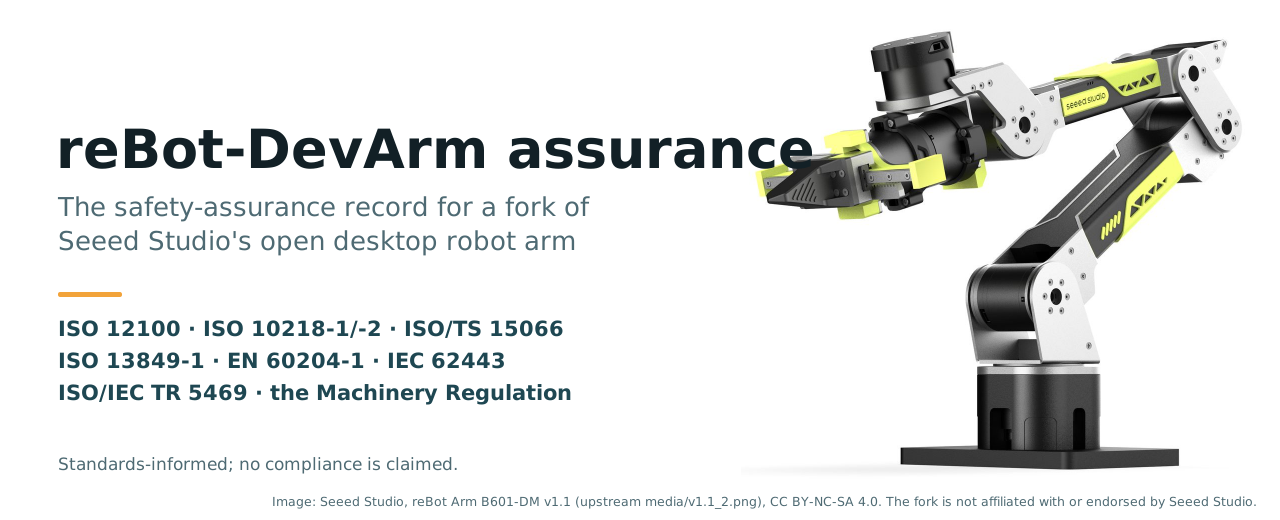
The arm is upstream's own image (media/v1.1_2.png, Seeed Studio, CC BY-NC-SA 4.0), set into the banner by
docs/assets/rebot/banner.py. The fork is not affiliated with or endorsed by Seeed Studio.
reBot-DevArm is an open desktop robot arm by Seeed Studio: six Damiao actuators and a gripper on one CAN bus, sheet-metal and printed links, a 24 V bench supply, and a software ecosystem (a Python SDK, a ROS 2 driver, LeRobot policies, Pinocchio kinematics) that lives in upstream repositories. This fork keeps upstream's hardware record and adds what a machine needs before it may work with a person in reach, and what upstream does not have: a risk assessment, safety functions with a required Performance Level, a hardwired emergency-stop chain, a supply that can be switched off, a controller safety layer between every command source and the motors, a cybersecurity case, and a safety case that publishes its own counter-evidence. The standards are the machinery set for an industrial robot: ISO 12100, ISO 10218-1/-2, ISO/TS 15066, ISO 13849-1, EN 60204-1, IEC 62443, ISO/IEC TR 5469 and the Machinery Regulation.
This wiki is the orientation layer. It explains how the project is organised, how the work flows through its phases and gates, which standard shapes which part of the record, and where to look. It never states a safety claim: those live in the assurance record, where they are reviewed.
Important
reBot-DevArm is research and education hardware and this record is a draft prepared for engineering review. Nothing has passed verification review, confirmation review or a functional safety assessment. The arm is not CE-marked, no safety function reaches any Performance Level today, there is no emergency stop in the documented design, and no configuration is approved for operation with anyone inside its 650 mm reach.
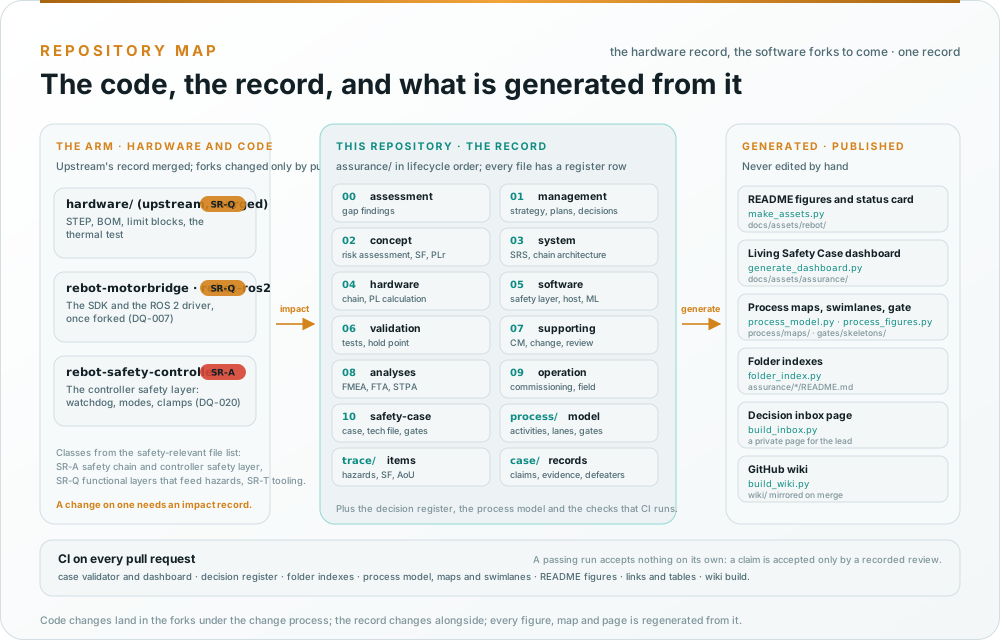
One repository holds upstream's hardware record, the fork's concept-phase package and the assurance record;
every figure, map and page is generated from the record and checked by CI. Generated by
make_assets.py.
How the repository is organized walks through it folder by folder.
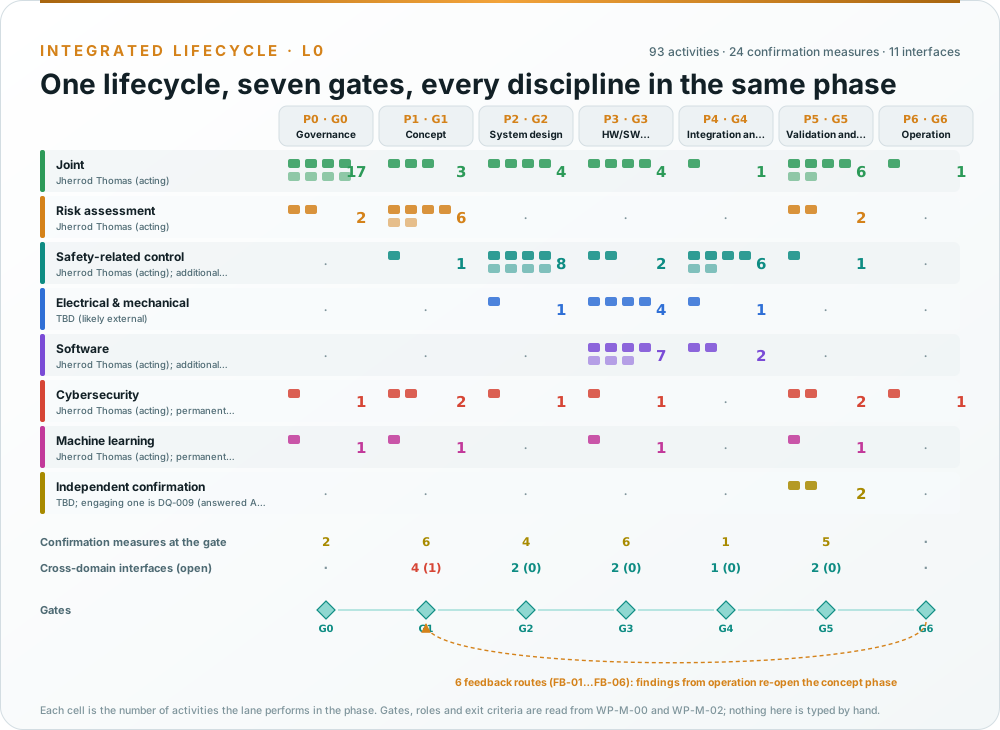
Every discipline works inside the same phase and decides at the same gate; there is no separate cybersecurity or
machine-learning lifecycle. Drawn from the process model by
process_figures.py. Processes explains the
phases, hold points and review levels; Process maps shows the swimlane of every phase.
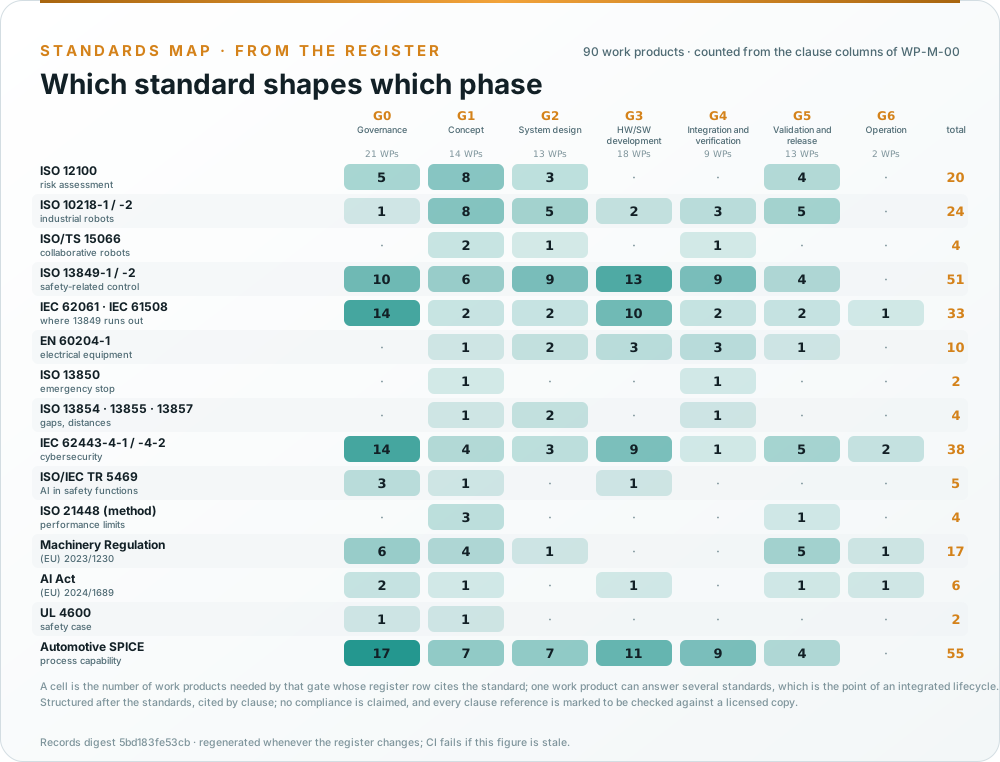
Counted from the clause columns of the work product register, so it changes whenever the register does. Standards at a glance gives the question each standard answers; How we use each standard says what is taken from each and what is not claimed; the standards tour walks a newcomer through them one page at a time.
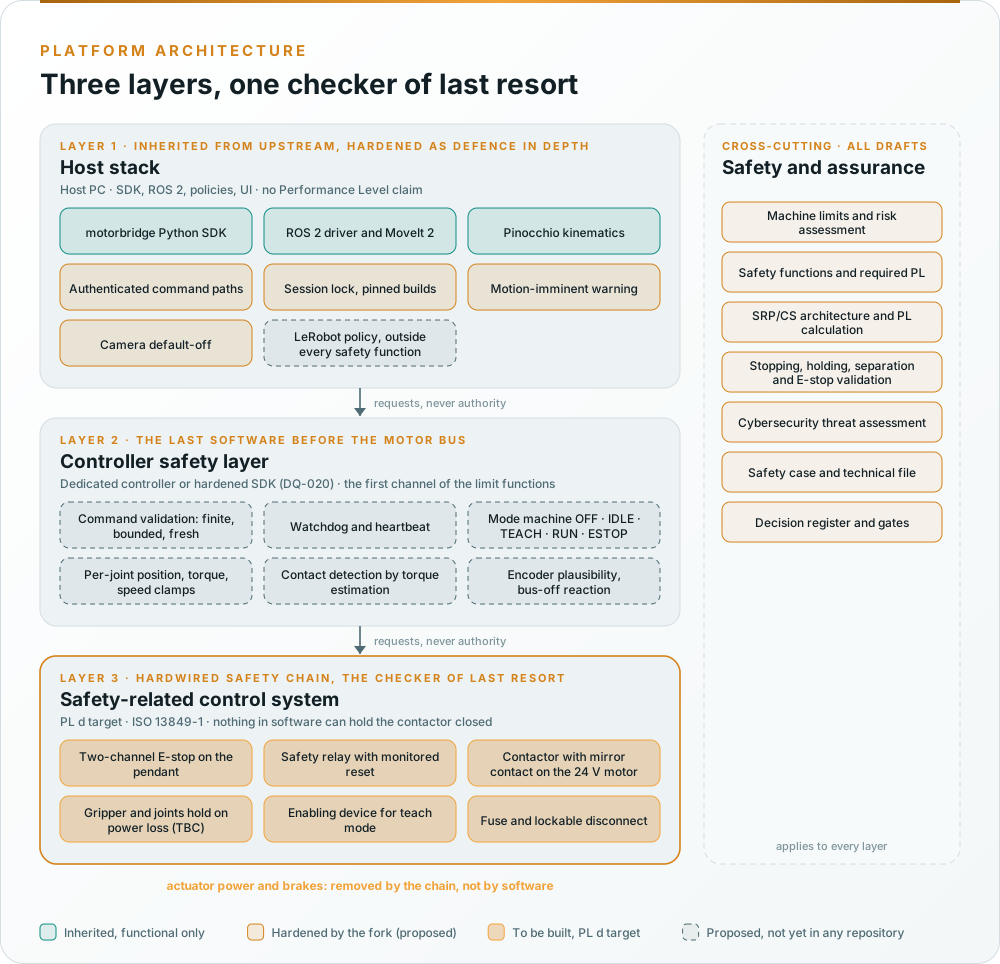
The host stack proposes, the controller safety layer checks, and a hardwired chain that nothing in software can override is the checker of last resort. Only the chain carries a PL target. The argument is WP-M-01 §6; Reading the safety case explains how the claims, evidence and defeaters are recorded.
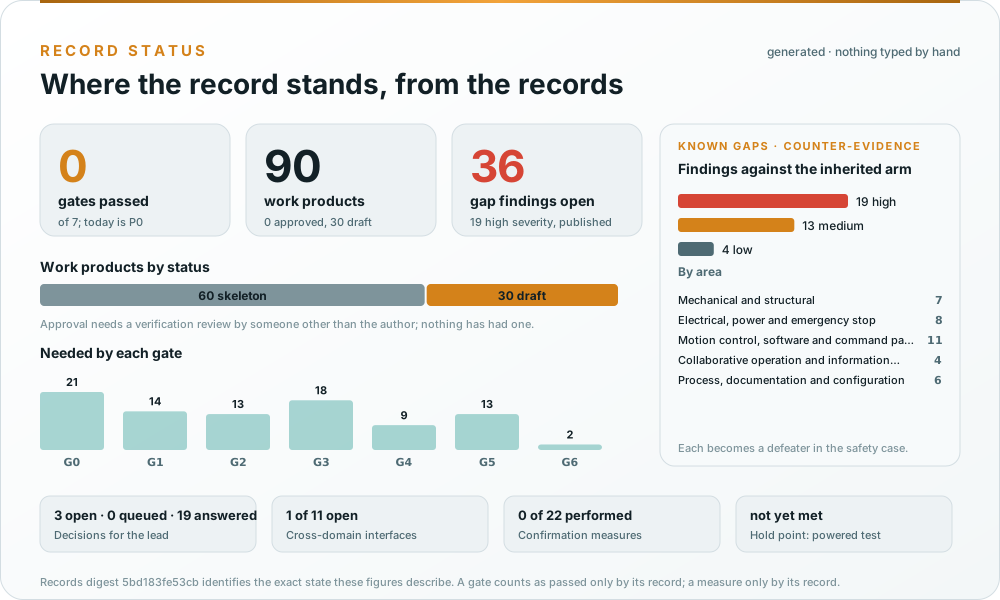
Generated from the records on every pull request; no number on it is typed by hand. The Living Safety Case dashboard shows the claims, evidence and defeaters the same way, and Roadmap and status lists what is drafted, skeleton and planned.
Assurance status represents recorded engineering evidence and review state. It does not constitute certification or approval for operation with a person in reach.
| If you want to | Read |
|---|---|
| See how the work is organised into phases, gates and activities | Processes, then the swimlanes on Process maps |
| See which standards apply and what each one is used for | Standards at a glance and How we use each standard |
| Learn the standards end to end, one page and one animated figure each | The standards tour |
| Understand how upstream's record, the package and the assurance record fit together | How the repository is organized |
| See what is done, active and planned | Roadmap and status |
| Know which arm the analysis is about | Reference arm |
| Review the safety argument | Reading the safety case |
| See the hazards drawn on the real CAD, with a person in reach | Hazard scenes |
| Review, audit or assess it independently | For the assessor |
| Follow or take part in the decisions | How decisions are made |
Decode WP-C-04, HZ-M01, SF-32, PLr d, DQ-006, OE-1
|
Glossary |
| Set up, branch, and open a pull request | Contributor guide |
| Report a vulnerability, an incident or a hazard | Reporting a safety concern |
| See what was merged, session by session | Session log |
| Get a short answer | FAQ |
- Not a work product. Nothing here carries a document-control header or counts as evidence.
- Not the place for hazard, requirement or safety-function text. Each page links to the record that owns it.
- Not illustrated by hand. Every image is a figure generated from the repository's records, or rendered from them at sync time.
-
Not edited in place. Pages are kept in the repository under
wiki/, reviewed by pull request, and mirrored here on merge. An edit made on the wiki itself is overwritten by the next sync.